The Ultimate Guide to Tool Discovery for AI Agents: MCP, A2A, and Revuo's Agent-Optimized Directory
The Ultimate Guide to Tool Discovery for AI Agents: MCP, A2A, and Revuo's Agent-Optimized Directory
In the rapidly evolving world of tool discovery for AI agents, this capability has become indispensable. AI agents—autonomous systems powered by large language models (LLMs)—need to dynamically identify, select, and integrate external tools to handle complex tasks far beyond their built-in knowledge. Traditional static function calling hardcodes tools into prompts, limiting flexibility. In contrast, advanced tool discovery for AI agents offers runtime adaptability, scalability for hundreds of tools, and drastically reduced context overhead, preventing token consumption that can reach thousands per interaction.[1][2]
This comprehensive pillar guide delves into the foundations of tool discovery for AI agents, key protocols like MCP (Model Context Protocol) and A2A (Agent2Agent), seamless integrations with popular frameworks such as AutoGen and OpenClaw, and the standout role of Revuo.ai as the premier agent-optimized directory. For developers building single agents or sophisticated multi-agent systems, mastering tool discovery for AI agents is the key to achieving genuine autonomy and efficiency.[3]
What is Tool Discovery for AI Agents?
Tool discovery for AI agents encompasses the sophisticated mechanisms that allow these intelligent systems to identify, evaluate, and access external tools or services dynamically at runtime, without dependence on predefined, prompt-embedded lists. This vital process leverages semantic search, precise capability matching, and standardized protocol-based querying to retrieve relevant tools from distributed registries, dedicated servers, or even peer agents in real-time.
Definition: Tool Discovery
The dynamic, context-aware process that empowers AI agents to query vast pools of available tools based on specific task requirements, semantically select the most optimal ones using rich metadata, and invoke them securely—essential for scaling integrations from dozens to thousands without performance degradation.[4]
In earlier approaches, AI agents relied on static tool schemas injected directly into prompts, resulting in severe "context bloat." For example, a single MCP server exposing over 90 tools could inflate token counts dramatically, slowing responses and increasing costs.[2] Tool discovery for AI agents addresses this by enabling on-demand tool listing, intelligent semantic filtering, and seamless execution chaining, transforming cumbersome workflows into fluid operations.
Core Components of Tool Discovery for AI Agents
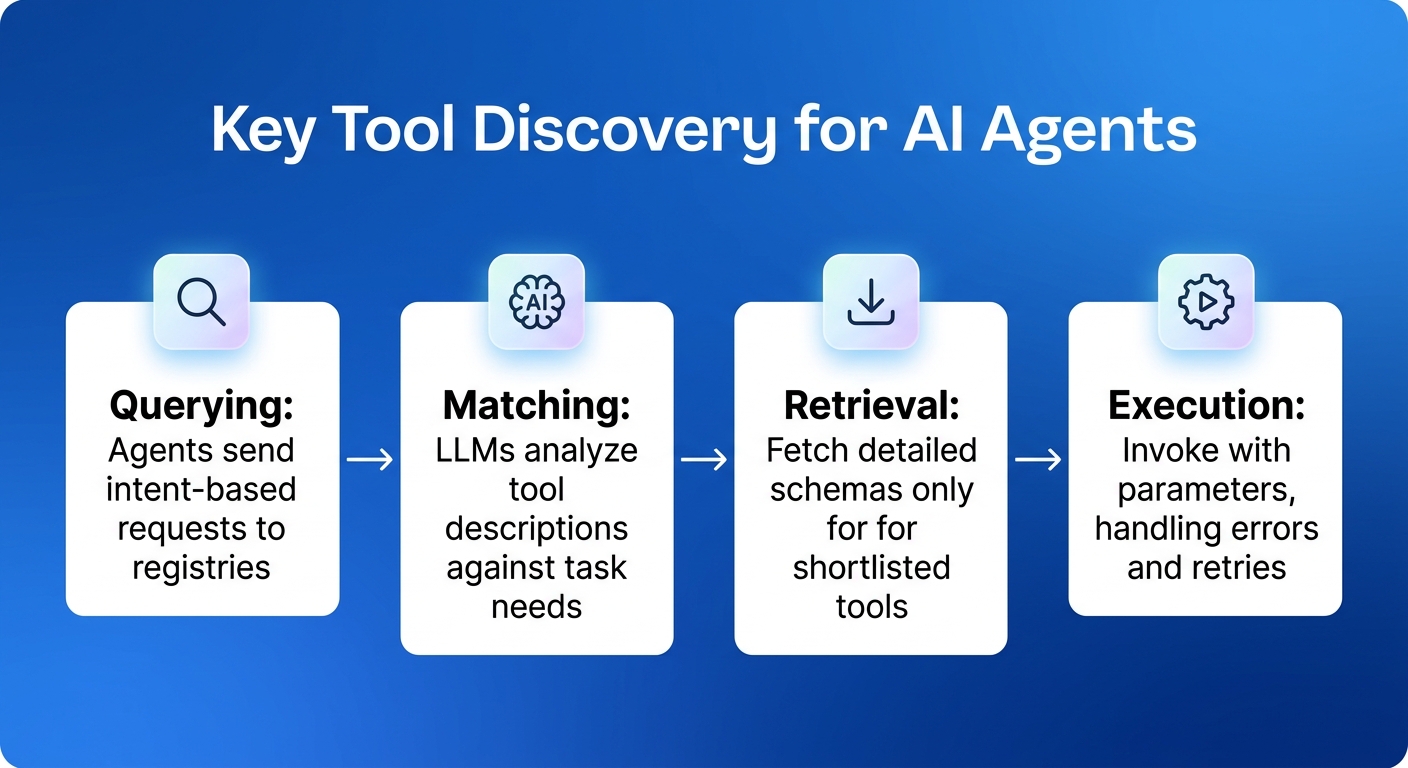
- Querying: Agents send intent-based requests to registries.
- Matching: LLMs analyze tool descriptions against task needs.
- Retrieval: Fetch detailed schemas only for shortlisted tools.
- Execution: Invoke with parameters, handling errors and retries.
This modular approach ensures tool discovery for AI agents is both efficient and extensible.
Why Tool Discovery Matters Now
The explosive growth in the AI agent ecosystem underscores the urgency of robust tool discovery for AI agents. Today, developers manage hundreds of tools across diverse categories, from data processing to web scraping, with daily token processing in enterprise environments reaching massive scales. Industry surveys indicate over 70% of decision-makers plan expanded agent adoption, yet persistent hurdles like tool overload hinder progress.[6]
Leading agents like Devin AI from Cognition have demonstrated remarkable success through seamless tool discovery for AI agents, powering complex software engineering tasks autonomously.
Key challenges in tool discovery for AI agents:
- Scalability: Hardcoding tools fails beyond 50-100 integrations.
- Token Efficiency: Full schema injection creates unnecessary overhead.
- Security: Risks of unauthorized or malicious tool access.
- Interoperability: Incompatibilities between frameworks like LangGraph, AutoGen, and LlamaIndex.
Key Takeaway
Mastering tool discovery for AI agents evolves rigid, prompt-bound systems into highly adaptive powerhouses, slashing integration times by up to 80% and paving the way for enterprise-grade autonomy.[3]
The Model Context Protocol (MCP): Core to Modern Tool Discovery
Launched in late 2024, the Model Context Protocol (MCP) has quickly become the gold standard for tool discovery for AI agents. This open protocol standardizes how applications expose tools, contextual data, and even prompts to LLMs and agents alike. MCP servers serve as intelligent intermediaries, enabling agents to perform tool discovery for AI agents through straightforward queries such as "list_tools."[7][3]
How MCP Powers Tool Discovery for AI Agents
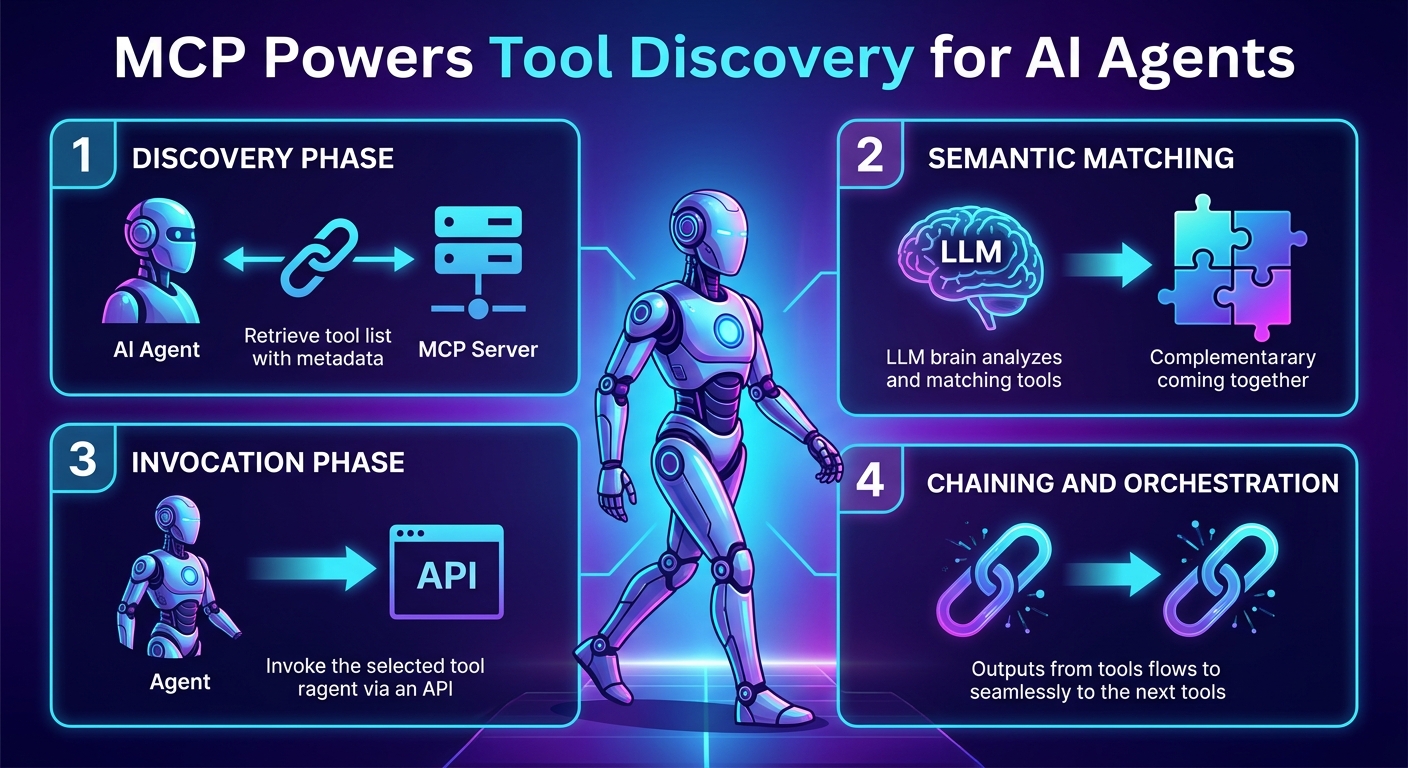
- Discovery Phase: Agents establish connections to MCP servers and retrieve comprehensive tool lists complete with metadata like names, descriptions, input parameters, and output formats.
- Semantic Matching: Leveraging embedded LLMs, agents perform intent-based matching, bypassing the need to load complete schemas upfront.
- Invocation Phase: Optimal tools are invoked through uniform APIs, supporting stateful interactions, error handling, and human-in-the-loop (HITL) safeguards.
- Chaining and Orchestration: Execution outputs are piped into subsequent tools, facilitating intricate multi-step workflows.
MCP excels in overhead reduction: Rather than loading thousands of tokens for an extensive suite like 90+ GitHub tools, agents retrieve only pertinent subsets on demand.[1] Production integrations, such as Azure AI Agent Service (announced May 2025) and Databricks' MCP support, affirm its maturity.[8][9]
Definition: MCP Server
A lightweight, deployable service that exposes an array of tools (e.g., file operations, API wrappers, database queries) through standardized MCP endpoints, accessible by clients like Claude Desktop, Cursor, or custom agent frameworks.[3]
For instance, Azure's dynamic registration feature allows AI agents to auto-discover and utilize MCP-exposed tools without manual reconfiguration, streamlining deployment in cloud environments.[8]
MCP Innovations, Registries, and Advanced Use Cases
- MCP-Zero: A streamlined mode for active discovery without any prior schema injection.[1]
- Official MCP Registry: Curates verified servers, including HAPI for seamless OpenAPI conversions.[10]
- Tool Search Enhancements: Anthropic's tools exemplify scaling tool discovery for AI agents to hundreds of options.
LangGraph agents, for example, employ meta-tools such as search_registry_tools to enable runtime tool discovery for AI agents across multiple MCP endpoints.[4]
Real-world case: A development team using MCP for GitHub integrations reduced context tokens by 70%, accelerating code analysis pipelines.
A2A Protocol: Agent-to-Agent Discovery and Collaboration
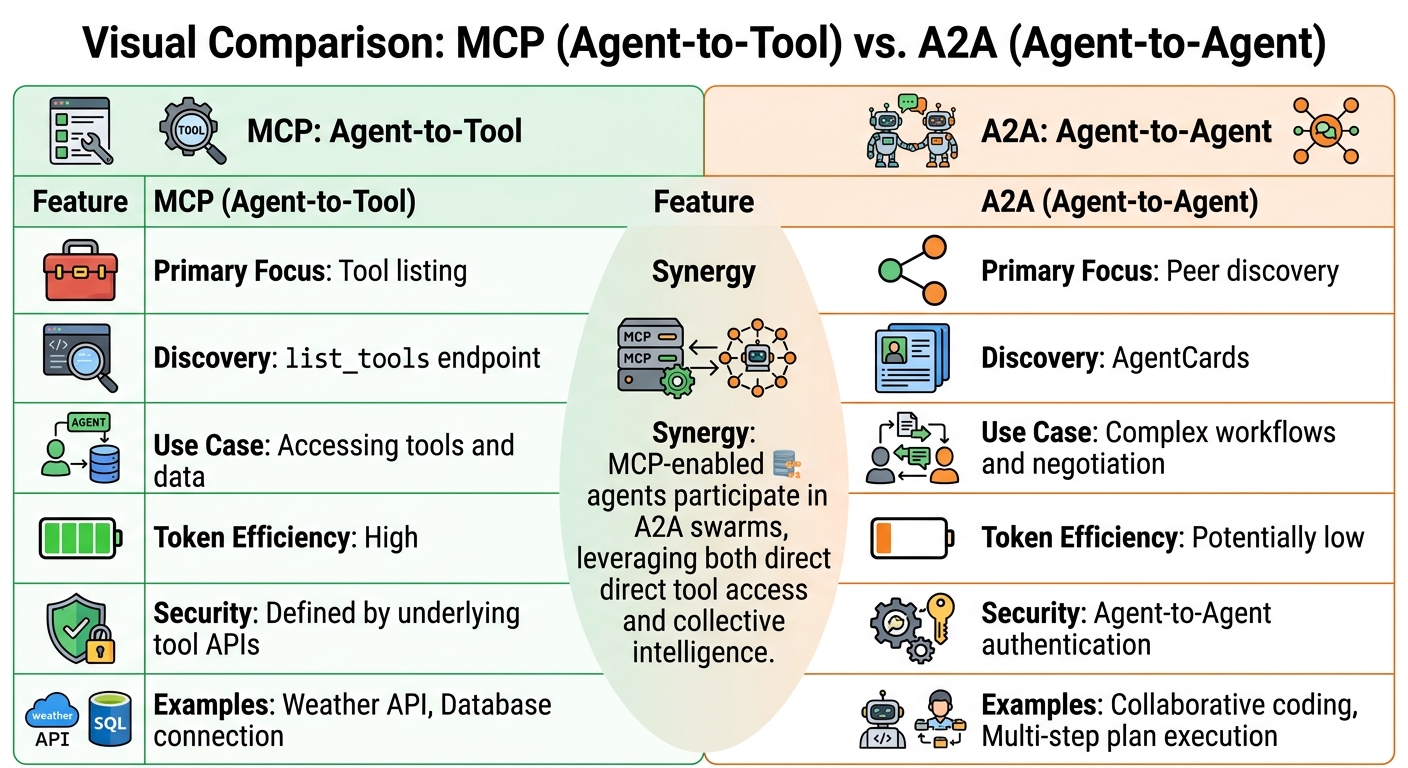
Complementing MCP's agent-to-tool focus, the Agent2Agent (A2A) protocol—introduced by Google in April 2025—facilitates direct peer-to-peer interactions among AI agents. A2A standardizes tool discovery for AI agents through "AgentCards," structured JSON manifests that detail an agent's capabilities, authentication requirements, endpoints, and performance metrics, enabling secure task delegation.[11][12]
A2A in Action: Enhancing Tool Discovery for AI Agents
Agents publish their AgentCards to public or private registries, allowing semantic queries like "Locate an agent specializing in image analysis and video processing." A2A manages state persistence, smooth task handoffs, privacy-preserving communication, and even UI/UX protocol negotiation—all without exposing proprietary internals.[13]
A2A synergizes with MCP by modeling peer agents as discoverable MCP resources, creating hybrid tool discovery for AI agents paradigms. Recent enhancements (July 2025) bolster multi-agent applications on platforms like Google Cloud and Microsoft Azure.[14][15]
| Feature | MCP (Agent-to-Tool) | A2A (Agent-to-Agent) |
|---|---|---|
| Primary Focus | Tool listing, invocation, context fetch | Peer discovery, task delegation, collab |
| Discovery Mechanism | list_tools endpoint, metadata |
AgentCards (JSON capabilities) |
| Use Case | Runtime tool selection (e.g., DB query) | Multi-agent workflows (e.g., handoff) |
| Token Efficiency | High (lazy loading) | Medium (structured comms) |
| Security | Server auth, HITL | Encrypted exchanges, capability scoping |
| Examples | GitHub MCP, Azure integration[8] | Google Cloud agents, Spring AI |
Key Takeaway
Combining MCP and A2A delivers complete tool discovery for AI agents: MCP for raw execution power, A2A for intelligent orchestration and collaboration.
Example: In a supply chain simulation, an MCP-equipped logistics agent delegates forecasting to an A2A-discovered specialist agent, optimizing end-to-end tool discovery for AI agents.
MCP vs. Traditional and Other Protocols
Legacy static tool calling, as in early OpenAI function calling, requires embedding full schemas upfront—impractical for scale. MCP's proactive, dynamic model draws inspiration from the Language Server Protocol (LSP) but tailors it for agent-driven tool discovery for AI agents, akin to npm's ecosystem for JavaScript.[3]
Emerging alternatives like IBM's ACP introduce governance layers, but MCP leads in core tool access. Other protocols (e.g., OpenAPI extensions) lack agent-native querying.
| Paradigm | Static Calling | MCP Dynamic | A2A Peer |
|---|---|---|---|
| Context Overhead | High | Low | Variable |
| Scalability | <50 tools | 100s+ | Multi-agent |
| Discovery | None | Runtime | AgentCards |
| Frameworks | All LLMs | Anthropic, OpenAI SDK[16] | Google, MS |
Framework Integrations: AutoGen, OpenClaw, LangGraph, and More
AutoGen (Microsoft Research) excels in multi-agent conversations, now enhanced with MCP for tool discovery for AI agents via dynamic registration. Agents query MCP servers on-the-fly, perfect for collaborative coding or research scenarios.[17] Example: An AutoGen group chat where one agent discovers database tools via MCP for real-time analytics.
OpenClaw (open-source, formerly Clawdbot), a versatile personal AI agent platform, incorporates plugins for advanced tool discovery for AI agents, including A2A sessions. Using Clawctl, users deploy hosted instances; Revuo.ai curates top providers.[5][18]
LangGraph: Offers graph-based workflows with search_registry_tools for semantic tool discovery for AI agents.[4]
For resources:
- [Best AutoGen Compatible Tools: Agent Directory Guide on Revuo]
- [Clawctl and OpenClaw: Top Hosting Providers and Tool Discovery for Agents]
- [LangGraph + MCP: Building Scalable Agent Workflows]
Revuo.ai: The Agent-Optimized Directory for Tool Discovery
Revuo.ai sets itself apart as the definitive, AI-powered directory for tool discovery for AI agents, meticulously curating MCP-compatible servers across 13+ categories including Data & Databases, Developer Tools, Files & Storage, and AI/ML frameworks.[5] Unlike general marketplaces (e.g., AWS Marketplace), Revuo provides agent-centric features: side-by-side comparisons, user reviews, compatibility filters for MCP/A2A/OpenClaw, and semantic search tailored for tool discovery for AI agents.[19]
Standout Revuo Features for Tool Discovery:
- Categorized MCP Servers: Files/Storage (e.g., cloud file processors), Web/Search APIs, Security & Auth tools.
- Specialized Agent Tools: Orchestration platforms (memory management, budget controls), Coding Remotes (Claude integration, GitHub Copilot).
- Advanced Filters & Comparisons: Evaluate integration ease, token efficiency, pricing.
- Hybrid Support: Listings for A2A-compatible agents and MCP hybrids.
| Revuo Category | Tool Examples | Agent Use Case |
|---|---|---|
| MCP Files & Storage | Cloud drives, processors | Dynamic file ops, batch processing[5] |
| AI Agent Orchestration | Prompt/memory tools, planners | Multi-step reasoning & planning |
| OpenClaw Hosting | Clawctl providers, custom deploys | Personal agent scaling |
| Developer Tools | GitHub MCP, CI/CD pipelines | Autonomous code generation & review |
Revuo fills critical gaps in search results, uniquely covering A2A/MCP intersections. Explore related guides:
- [How Revuo Enables MCP Tool Discovery for AI Agents vs. Classic Directories]
- [A2A Protocol Essentials: Discovering Agent-to-Agent Tools on Revuo]
- [Top 10 MCP Servers for AutoGen on Revuo.ai]
Actionable Steps: Implementing Tool Discovery for AI Agents
Get started with tool discovery for AI agents today:
- Set Up an MCP Client: Install Claude Desktop, Cursor, or the OpenAI Agents SDK.[16]
- Explore Revuo.ai: Use filters to discover MCP servers by category and compatibility.
- Query Available Tools: Implement
client.list_tools(server_url)for listings. - Incorporate A2A: Generate and publish AgentCards for peer discovery.
- Prototype with OpenClaw: Integrate MCP plugins using Clawctl for rapid testing.
- Scale via AutoGen: Dynamically register MCP tools in multi-agent groups.
- Monitor & Optimize: Track token usage, refine semantic prompts.
Expanded Python Example (LangGraph + MCP):
from langgraph import search_registry_tools, AgentState
from langchain_core.tools import tool

@tool
def analyze_repo(repo_url: str):
    """Analyze GitHub repo using discovered tools."""
    pass

tools = search_registry_tools("mcp://github-server")

workflow = (
    AgentState()
    | {"tools": tools}
    | agent.invoke({"task": "Analyze this repo: " + repo_url})
)
result = workflow.invoke({})
print(result)
This snippet demonstrates runtime tool discovery for AI agents in a graph workflow.[4]
Best Practices for Tool Discovery:
- Prioritize semantic over keyword matching.
- Implement HITL for sensitive operations.
- Monitor token budgets with logging.
- Build hybrid MCP/A2A stacks for versatility.
- Test across frameworks for interoperability.
The Future of Tool Discovery for AI Agents
The horizon for tool discovery for AI agents brims with promise: Unified multi-protocol ecosystems blending MCP, A2A, and governance standards like ACP. Directories like Revuo.ai will accelerate discovery, while community discussions on platforms like X emphasize CLI tools and expanding MCP indexes (now over 95). Innovations include agent-ready codebases with standardized AGENTS.md files and auto-generated registries.
As agent adoption surges, expect standardized development kits (e.g., Google's ADK) and marketplace explosions, further solidifying tool discovery for AI agents as the backbone of autonomous AI.
FAQ: Tool Discovery for AI Agents
1. Where do AI agents discover tools?
Primarily through MCP registries like Revuo.ai and the official MCP site; A2A registries for peer agents.[10]
2. How does MCP reduce token bloat in tool discovery for AI agents?
Through lazy loading: Agents query lightweight lists first, fetching full schemas only for selected tools.[1]
3. What's the key difference between MCP and A2A for tool discovery?
MCP targets tools/services; A2A enables agent-to-agent collaboration and delegation.
4. Is Revuo.ai compatible with AutoGen, OpenClaw, or LangGraph?
Absolutely—dedicated MCP listings for AutoGen; OpenClaw hosting category; semantic filters for LangGraph meta-tools.[5]
5. How can agents handle discovery across dozens of MCP servers?
Employ meta-tools, Revuo's semantic search, or federated queries for efficient filtering.[4]
6. What are real-world production examples of MCP-based tool discovery?
Azure AI Agent Service, Databricks integrations, GitHub MCP servers.[8]
7. What's emerging after MCP and A2A in tool discovery for AI agents?
ACP for governance; unified kits like ADK; AI-driven auto-discovery engines.
8. How does Revuo.ai stand out from AWS Marketplace for tool discovery?
Agent-optimized focus on MCP/A2A with reviews/comparisons vs. general AI listings.[5][19]
9. Can tool discovery for AI agents support stateful workflows?
Yes, MCP and A2A both handle sessions, context persistence, and iterative chaining.
10. How to secure tool discovery for AI agents in production?
Use auth tokens, HITL approvals, capability scoping, and audited registries like Revuo.
Revuo.ai empowers your AI agents with unparalleled tool discovery for AI agents. Dive into MCP servers today and architect the autonomous future.