
Mirakl Catalog Manager
Unclaimed verified 6 oct 2026Streamline supplier catalog onboarding
TL;DR
Mirakl Catalog Manager is an enterprise-grade data orchestration platform designed to automate the onboarding, enrichment, and harmonization of supplier product data. It is primarily for large-scale retailers and B2B distributors who need to scale their digital assortments rapidly while maintaining high data quality through AI-powered mapping and validation.
What Users Actually Pay
No user-reported pricing yet.
Our Take
Mirakl Catalog Manager holds a dominant position in the marketplace enablement space, functioning as a sophisticated bridge between third-party supplier data and a retailer's front-end catalog. Its primary strength lies in its ability to handle massive scale; where manual CSV uploads would fail, Mirakl's AI-driven mapping and 'Golden Record' logic ensure that disparate supplier inputs are unified into a consistent customer experience. This makes it an essential tool for companies moving from a traditional e-commerce model to a high-volume marketplace model. However, the platform is not a 'plug-and-play' solution. The sheer depth of its features—including complex attribute mapping and advanced moderation workflows—requires a significant investment in data strategy and technical oversight. While the AI assists in category matching, the initial setup of business rules and taxonomies can be daunting for organizations without a mature data governance team. Ultimately, Mirakl Catalog Manager is best suited for established enterprise players who have outgrown standard PIM (Product Information Management) capabilities and need a specialized engine to manage the chaos of third-party seller data. It is less a tool for small businesses and more a mission-critical infrastructure for global retailers like Macy's or Decathlon.
Alternatives
Ranked by Revuo score — paid tiers never affect order.FacetFlux · Revuo-affiliated
AI product data enrichment for industrial suppliers

Akeneo
The open-source PIM that scales with your business

Pimcore
Open-source digital platform for PIM, MDM, DAM, and more

Salsify
The complete commerce experience management platform

inriver
Power your product journey with the most complete PIM solution.

Plytix
The Product Information Management (PIM) platform for everyone.
Pros
- + AI-driven auto-mapping significantly reduces the manual effort required to align supplier categories with the host's taxonomy.
- + Sophisticated deduplication logic ensures a single global SKU, preventing customer confusion from multiple identical listings.
- + High-transparency moderation workflows allow operators to provide real-time, actionable feedback to suppliers regarding data errors.
- + Seamless integration with the broader Mirakl Marketplace Platform, creating a unified ecosystem for seller management and order processing.
Cons
- - The initial configuration and data mapping process can be extremely time-consuming and requires high technical proficiency.
- - Error messages during the bulk upload process are occasionally reported as cryptic, making it difficult for non-technical suppliers to troubleshoot.
- - The premium enterprise pricing model and implementation costs place it out of reach for most mid-market businesses.
Agent Readiness
52/100Mirakl Catalog Manager is highly ready for autonomous AI agents. It features a comprehensive, well-documented REST API that covers almost every action available in the UI, from catalog ingestion to product moderation. The presence of a sandbox environment and versioned APIs allows agents to test data mapping and validation logic safely. Furthermore, native connectors on iPaaS platforms like Make and Zapier, combined with robust webhook support, enable agents to build event-driven workflows that respond instantly to supplier data changes or moderation flags.
Last checked Jul 1, 2026
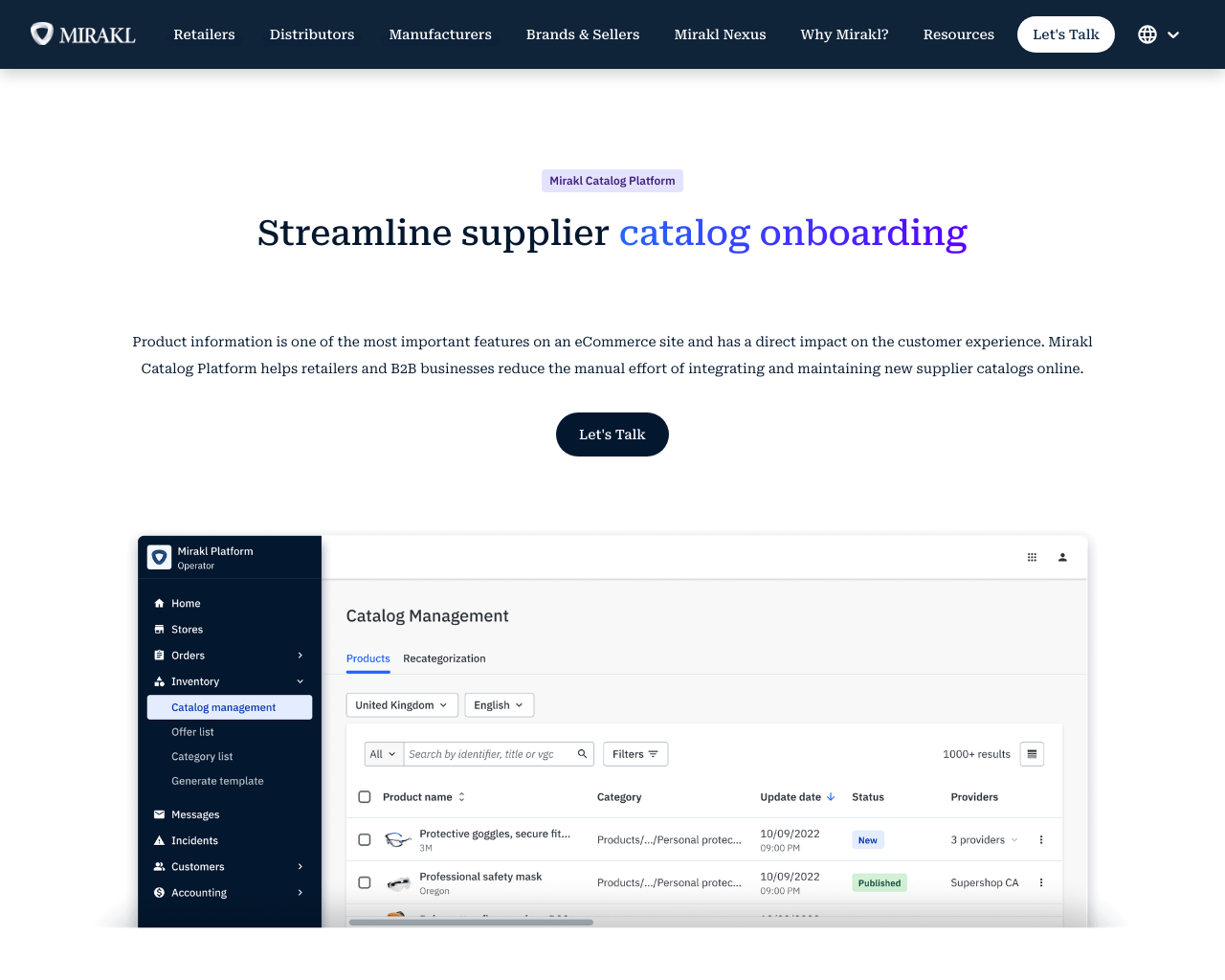
Screenshot
[ features ]
Product Data Management
Core capabilities for managing product data including import, validation, versioning, and localization.
Ability to import and export large volumes of product data via CSV, Excel, or other formats.
Configurable rules to validate product data quality and completeness.
Track changes to product data over time with ability to rollback.
Support for product variants with inherited attributes from parent products.
Multi-language support for product content.
How many languages are supported out of the box.
Supplier Portal
Capabilities for supplier onboarding, data collection, and collaboration.
Portal where suppliers can directly update their product information.
Structured process for onboarding new suppliers with approvals.
Automated scoring of supplier-provided data quality.
Analytics on supplier data quality and response times.
White-label supplier portal with custom branding.
Compliance & Security
Security certifications, compliance features, and access control capabilities.
SOC 2 Type I or Type II certification.
ISO 27001 information security certification.
Built-in tools for GDPR compliance (data export, deletion, consent).
Complete audit log of all data changes.
Granular permissions based on user roles.
Single Sign-On integration support.
eCommerce Integrations
Connectivity with other systems including DAM, ERP, e-commerce platforms, and marketplaces.
Integration with Digital Asset Management systems.
Native integrations with ERP systems.
Pre-built connectors for e-commerce platforms.
Direct syndication to online marketplaces.
Type of API available for custom integrations.
Outbound webhooks for event-driven integrations.
Listing AI & Automation
Artificial intelligence and automation capabilities for content generation, categorization, and optimization.
AI-powered generation of product descriptions and content.
AI tools for image optimization, background removal, etc.
AI-powered automatic product categorization.
Automatic extraction of product attributes from descriptions or images.
Built-in machine translation for product content.
eCommerce Publishing & Channels
Capabilities for distributing product content across multiple channels and formats.
Publish product data to multiple channels from a single source.
Generate print-ready catalogs and datasheets.
API-first architecture for headless commerce.
Analytics on product performance across digital channels.
Schedule product updates to go live at specific times.
Compare With
Reviews
No reviews yet. Be the first to review Mirakl Catalog Manager!