
yolocode
Unclaimed verified 6 oct 2026hire Claude in 7 lines of code
TL;DR
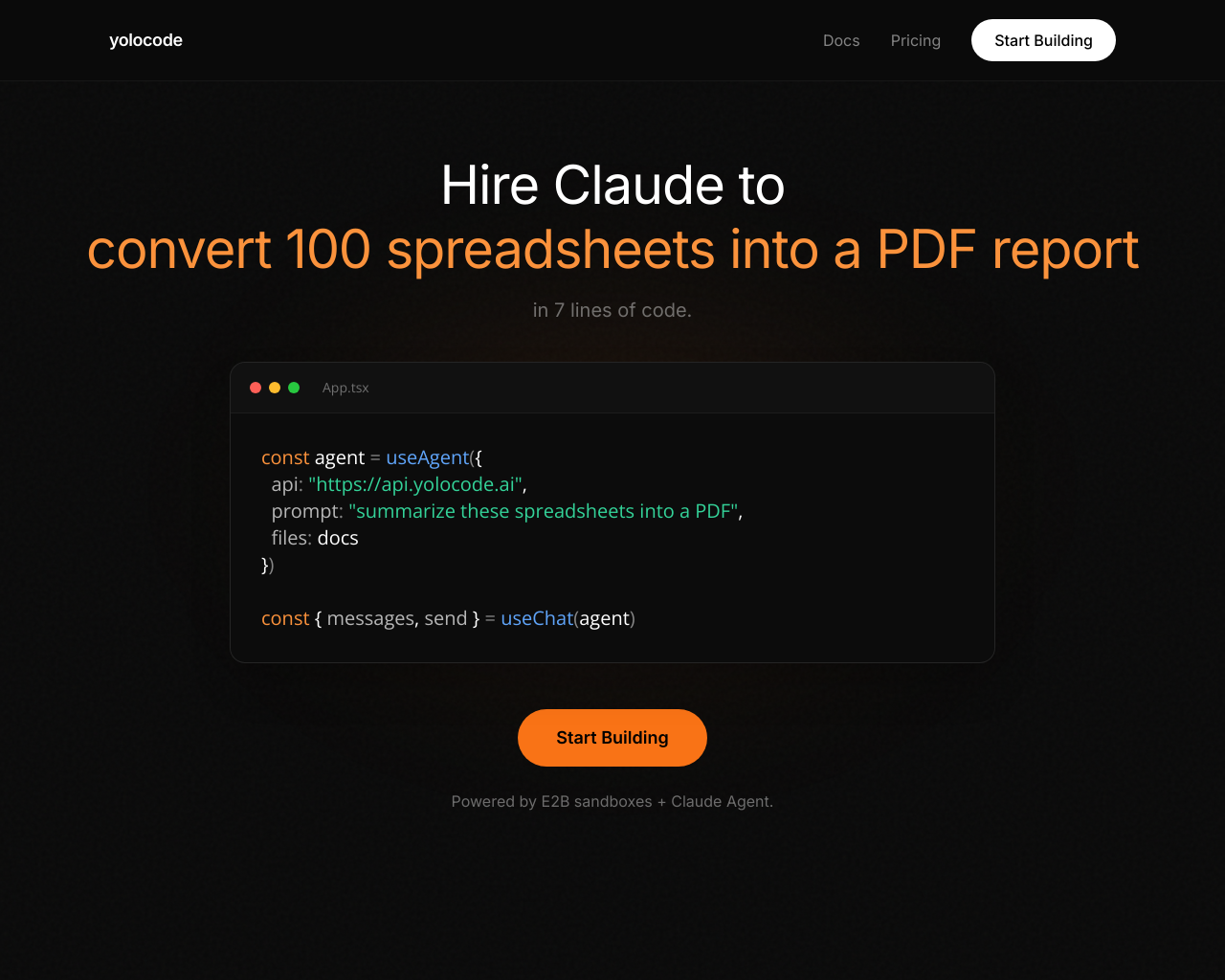
yolocode is a developer API for running Claude-powered agents inside disposable Ubuntu/E2B sandboxes. It is designed for developers building code-analysis, document-processing, media-processing, repository-automation, and other workflows that require terminal access, files, packages, and external tools. Its key differentiator is combining Claude Agent with an execution environment, MCP integrations, and streaming behind a relatively simple API.
What Users Actually Pay
No user-reported pricing yet.
Our Take
yolocode occupies an early-stage position between a hosted coding-agent platform and an agent-execution API. Instead of providing only model completions, it gives Claude access to an isolated Linux environment where it can run shell commands, manipulate files, install packages, access repositories, and iterate through failures. This makes it better suited to execution-heavy workflows than to conventional chat or simple structured-output tasks. Its strongest advantage is convenience. Sandbox provisioning, Claude configuration, filesystem access, terminal tooling, streaming, repository operations, and external-service access are presented as one developer workflow. The documented examples cover cURL, JavaScript/TypeScript, React, React Native, file uploads, command execution, GitHub repositories, and Vercel AI SDK-compatible streaming. The primary limitation is maturity and clarity. The public product positioning emphasizes a simple low-latency agent API, while the detailed documentation exposes a more infrastructure-oriented sandbox API involving staging endpoints, GitHub authentication, per-sandbox hosts, and lifecycle management. Publicly available materials do not clearly establish formal API versioning, an OpenAPI specification, a public changelog, or a status page. The best fit is a technically sophisticated startup or product team that wants to add code execution, file transformation, repository operations, or self-healing workflows quickly. It is less clearly suited to regulated or mission-critical workloads until the company provides more information about security, data retention, sandbox isolation, observability, concurrency, credential handling, and production support.
Alternatives
Ranked by Revuo score — paid tiers never affect order.
E2B
Secure, open-source cloud environments for AI agents to run code and use real-world tools.

Omnara
Mobile & Voice Interface for Claude Code & Codex

Happy Coder
Spawn and control multiple Claude Codes in parallel. Runs on your hardware, works from phone and desktop, costs nothing. Open source.

Aider
AI Pair Programming in Your Terminal

Runpod
AI cloud infrastructure for experimenting, training, fine-tuning, deploying, and scaling GPU workloads.
Together AI
The AI Native Cloud for building, training, and deploying AI applications with open models.
Pros
- + Full execution environment with Ubuntu, shell access, filesystems, package managers, and tools such as ffmpeg, ImageMagick, npm, pip, grep, and cargo.
- + Well suited to iterative workflows where Claude can test commands, diagnose failures, install dependencies, and retry operations.
- + Developer-friendly integration model with REST-style operations, SSE streaming, JavaScript/TypeScript examples, React support, React Native support, and Vercel AI SDK compatibility.
- + Broad MCP integration story, with the product advertising more than 200 integrations including Linear, Notion, and GitHub.
- + Limited Reddit discussion was generally positive about remote or mobile coding use cases and founder support.
Cons
- - There are no verified G2, Capterra, or TrustRadius reviews, so independent customer validation is very limited.
- - The marketing positioning and detailed documentation appear somewhat inconsistent, including differences between the advertised low-latency API and staging-oriented sandbox examples.
- - The documented sandbox API uses GitHub bearer-token authentication, which may be awkward for general-purpose backend applications that do not center on GitHub.
- - No publicly indexed OpenAPI specification, formal API versioning, public changelog, or public status page was found.
- - Public documentation leaves important production questions open, including data retention, regional deployment, concurrency, audit logs, network controls, and enterprise compliance.
Agent Readiness
38/100yolocode is moderately ready for autonomous-agent prototypes and controlled developer tools. Its sandbox-based execution model is a strong fit for agents that need terminal access, files, package installation, repository operations, and iterative debugging. REST-style endpoints, SSE streaming, file uploads, GitHub workflows, MCP integrations, and Vercel AI SDK support provide a useful foundation. However, the platform appears early-stage: no public OpenAPI specification, clear versioning scheme, changelog, or status page was identified; documented authentication and staging-oriented endpoints may require design work for production deployment. Before adopting it for critical autonomous workflows, teams should validate API stability, credential handling, sandbox isolation, deletion semantics, data retention, observability, concurrency, and security/compliance controls.
Last checked Oct 3, 2026
Screenshot
[ features ]
Compliance & Security
Security certifications, compliance features, and access control capabilities.
SOC 2 Type I or Type II certification.
ISO 27001 information security certification.
Built-in tools for GDPR compliance (data export, deletion, consent).
Complete audit log of all data changes.
Granular permissions based on user roles.
Single Sign-On integration support.
Accessibility & Interfaces
Features related to how users access and interact with the AI coding tools across devices and input methods.
Whether native iOS/Android apps are available for control and interaction.
Availability of a web-based UI for accessing sessions from any browser.
Hands-free voice interaction for commands, ideation, or code generation.
Seamless session handoff and context preservation across devices.
Terminal-based access for power users preferring command-line workflows.
AI Model & Language Support
Compatibility with AI models and programming languages.
Main large language model(s) supported.
Ability to use multiple or any LLM providers.
Number and types of languages handled.
Session & Workflow Management
Tools for managing coding sessions, parallelism, and integrations.
Ability to run and control multiple AI coding sessions simultaneously.
Maintains full session context across interruptions or device switches.
Deep integration with Git repos for editing, commits, and repo mapping.
Sessions continue if host machine goes offline via cloud relay.
Runs agents in isolated sandboxes with tools and filesystem access.
Pricing & Licensing
Cost structure, open-source status, and usage limits.
Primary billing structure.
Can run entirely on user hardware without external services.
Compare With
Reviews
No reviews yet. Be the first to review yolocode!