
AutoGen
Unclaimed verified 10 nov 2026A framework for building AI agents and applications
TL;DR
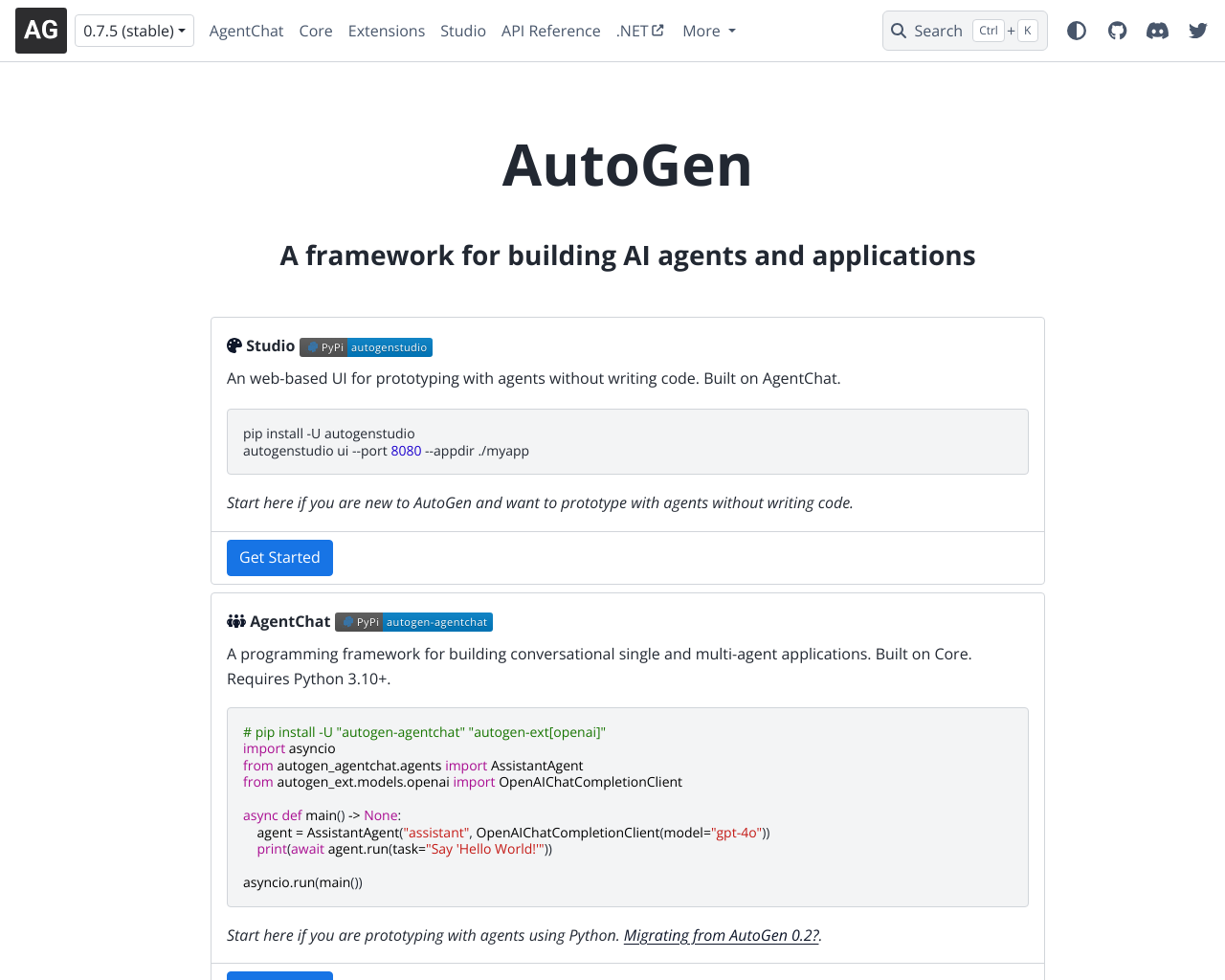
AutoGen is an open-source programming framework by Microsoft Research for building conversational single- and multi-agent AI applications in Python and.NET. It is designed for software developers and AI researchers creating collaborative agent systems such as automated code generation, research pipelines, and critique loops. Its key differentiator is an asynchronous, event-driven actor model combining conversation-based orchestration with native sandboxed Docker execution and Model Context Protocol (MCP) tool integration.
What Users Actually Pay
No user-reported pricing yet.
Our Take
AutoGen was among the earliest and most influential multi-agent frameworks, popularizing the concept of complex LLM problem-solving through structured multi-agent dialogue rather than rigid chains. The v0.4 rewrite decoupled the framework into a three-tier architecture: Core (an asynchronous, actor-based message passing runtime), AgentChat (high-level conversational patterns), and Extensions (pluggable toolkits, execution environments, and cloud runtimes). Its key strengths include dual Python/C# support, first-class Model Context Protocol (MCP) server integration, distributed execution via gRPC, and built-in Docker/Jupyter sandboxed code execution. AutoGen also natively integrates with OpenTelemetry for distributed tracing of inter-agent messaging, making it robust for local experimentation and developer tooling. However, AutoGen faces limitations when applied to strict, production-grade business processes. Because control flow is governed by conversational messages rather than explicit deterministic graphs, enforcing rigid branching, cycles, and checkpoints can require extensive prompt engineering. Without carefully configured termination conditions, agents can enter expensive recursive feedback loops. Additionally, Microsoft placed the core `microsoft/autogen` repository into community maintenance mode while redirecting enterprise focus toward the Microsoft Agent Framework (and community-led AG2). AutoGen remains best suited for exploratory multi-agent research, collaborative code generation and review loops, interactive simulation teams, and developers who need low-level asynchronous message-passing infrastructure.
Alternatives
Ranked by Revuo score — paid tiers never affect order.


Pros
- + Actor-model message passing and multi-agent conversational orchestration (ideal for coder-critic review loops)
- + Built-in sandboxed code execution environments via Docker and Jupyter
- + Native Model Context Protocol (MCP) support for STDIO, SSE, and HTTP tool servers
- + Dual SDK availability across Python (3.10+) and .NET / C#
- + Integrated OpenTelemetry observability for distributed inter-agent tracing
Cons
- - Non-deterministic conversational control flow makes strict branching and state machines harder to enforce than in graph-based frameworks
- - Susceptible to runaway recursive dialogue loops that lead to rapid token and API cost escalation
- - Official Microsoft repository is in maintenance mode, causing an ecosystem split with AG2 and Microsoft Agent Framework
- - Steep architectural transition and breaking changes between legacy v0.2 and v0.4
Agent Readiness
52/100AutoGen is exceptionally well-suited as a foundation for autonomous AI agents, providing native Model Context Protocol (MCP) client adapters, distributed gRPC worker runtimes, Docker-sandboxed code execution, and OpenTelemetry instrumentation. While it lacks out-of-the-box SaaS connectors for no-code platforms like Zapier or Make, it offers rich programmatic extensibility in Python and .NET along with a local sandbox UI via AutoGen Studio.
Last checked Nov 10, 2026
MCP Integrations
1 serverNeeds a self-provisionable API key
Create and manage AI agents that collaborate and solve problems through natural language interacti…
Last checked Oct 18, 2026
Screenshot
Compare With
Reviews
No reviews yet. Be the first to review AutoGen!