
Descope
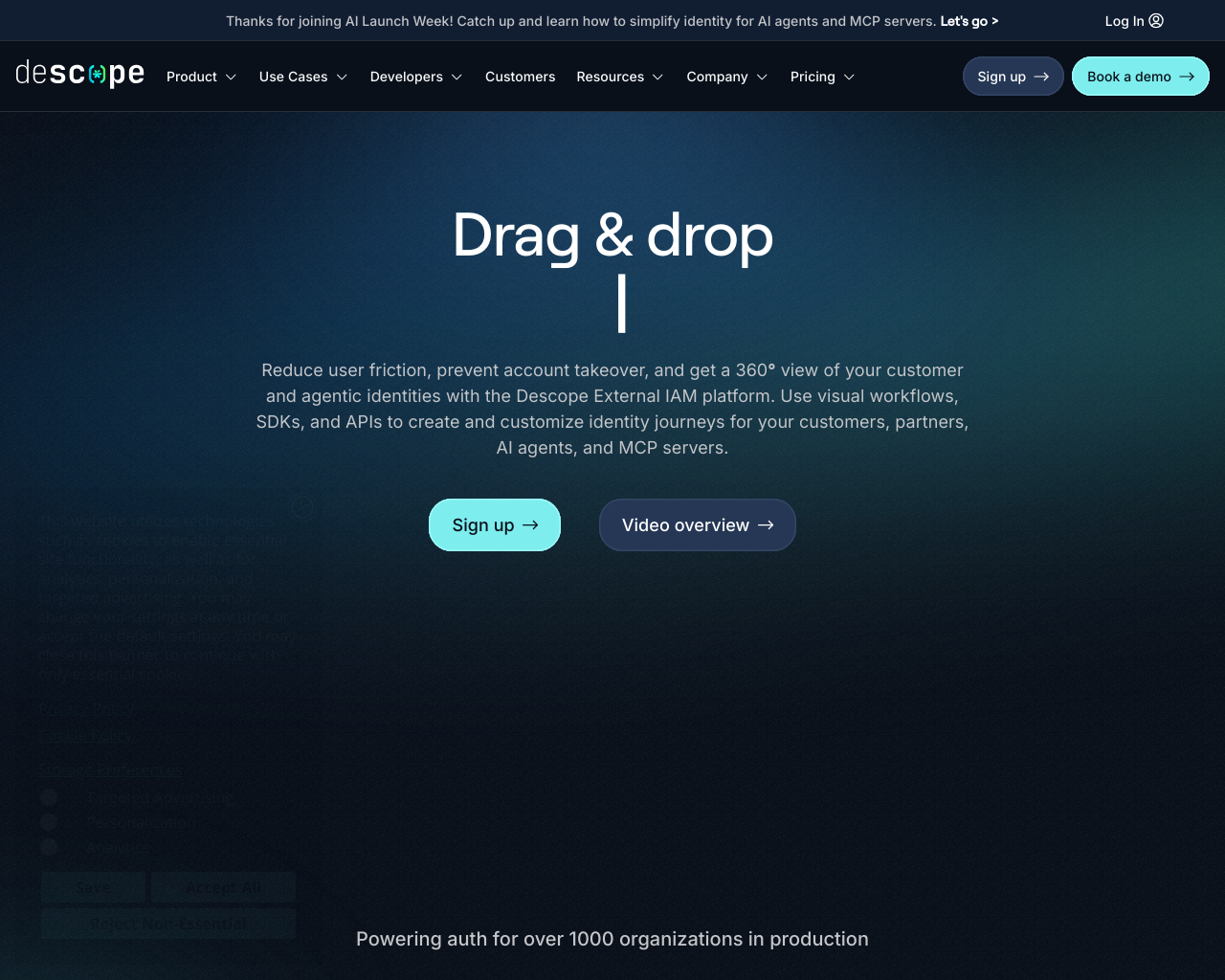
Unclaimed verified 6 oct 2026Reduce user friction, prevent account takeover, and get a 360° view of your customer and agentic identities with the Descope External IAM platform.
TL;DR
Descope is a customer identity and access management (CIAM) platform that enables developers to build and orchestrate authentication, authorization, and user journeys via visual drag-and-drop workflows and SDKs. Designed for B2B and B2C SaaS as well as AI agent ecosystems, its key differentiator is the no-code 'Descope Flows' canvas paired with native support for passwordless authentication and dedicated agentic IAM infrastructure.
What Users Actually Pay
No user-reported pricing yet.
Our Take
Descope has established a strong market presence against legacy identity vendors like Auth0, Okta, and AWS Cognito, as well as modern developer CIAM platforms like Clerk and Stytch. Founded by cybersecurity veterans, Descope focuses on visual orchestration to decouple frontend login UX and security policy logic from core application codebases. The platform's primary strength lies in enterprise B2B enablement. Out-of-the-box multi-tenancy, self-service SAML/OIDC SSO, SCIM provisioning, RBAC/ReBAC, and tenant impersonation capabilities significantly accelerate enterprise readiness for SaaS products. In addition, Descope has expanded proactively into agentic identity with its Agentic Identity Hub, offering dedicated OAuth 2.1 authorization servers and token-minting tools for autonomous AI agents and Model Context Protocol (MCP) servers. Potential limitations center around edge-case customization where visual abstractions can create debugging complexity when dealing with non-standard JWT claim topologies or deeply nested logic. Additionally, while the free tier offers up to 7,500 MAUs, jumping to paid tiers represents a noticeable step-up in cost for early-stage bootstrapped projects. Descope is best suited for engineering teams building B2B SaaS products that require enterprise-grade federation, companies modernizing complex authentication flows without writing brittle custom glue code, and AI developers building secure agent-to-tool authentication pipelines.
Alternatives
Ranked by Revuo score — paid tiers never affect order.



Pros
- + Visual drag-and-drop Flow builder lets teams design, test, and iterate on auth journeys without deploying frontend code changes.
- + Comprehensive B2B multi-tenancy features including self-service SSO/SAML, SCIM provisioning, and user impersonation widgets.
- + Broad out-of-the-box passwordless and security support including Passkeys, WebAuthn, Magic Links, OTP, and risk-based MFA.
- + Dedicated Agentic IAM features designed for AI agents and Model Context Protocol (MCP) servers.
- + Extensive SDK and framework support covering Node.js, Go, Python, React, Kotlin, Swift, and Flutter alongside Terraform/Pulumi providers.
Cons
- - Pricing step-up from the free tier to the initial paid plan starts at $249 per month.
- - Debugging complex visual flow branching and custom JWT attributes can introduce a learning curve.
- - Deep customization documentation for niche or non-standard authentication topologies can require direct support guidance.
Agent Readiness
70/100Descope is exceptionally well prepared for autonomous agent interaction and agentic workflow governance. It provides comprehensive REST APIs with OpenAPI specifications, programmatic SDKs across major languages, multi-environment sandboxing, and official Terraform/CLI providers. Furthermore, Descope provides dedicated Agentic IAM features, including dynamic client registration and scoped short-lived token management specifically built for AI agents communicating with Model Context Protocol (MCP) servers and external tools.
Last checked Sep 22, 2026
Screenshot
[ features ]
Geostrategic Position
Information on which part of the world this product / vendor belongs to, i.e. the country of their headquarters primarily, but also their hosting options etc.
Find which geostrategic world region the headquarter is located in. Relevant for compliance questions (e.g., CLOUD Act) or risk of cut-off in case of conflicts. For example, some EU companies are worried about the US and would definitely not host their customer with Chinese or Russian companies.
The hosting provider that is used to host this product, if any.
The available hosting locations, if you can choose
Compliance & Security
Security certifications, compliance features, and access control capabilities.
SOC 2 Type I or Type II certification.
ISO 27001 information security certification.
Built-in tools for GDPR compliance (data export, deletion, consent).
Complete audit log of all data changes.
Granular permissions based on user roles.
Single Sign-On integration support.
Developer Experience
Tools and abstractions easing agent development and iteration.
No-code/low-code UI for designing agent workflows.
OpenAI API-compatible endpoints or SDKs.
Available as open-source with community contributions.
Programming languages with official SDK support.
Ready-to-use, customizable UI elements for auth flows.
Self-service admin dashboard for customers to manage users/orgs.
Supported frontend frameworks with dedicated guides/components.
Authentication Methods
Core authentication flows and options supported by the platform.
Supports passwordless authentication via magic links, passkeys, or biometrics.
Supported third-party social login providers.
Supported multi-factor authentication methods.
Built-in protection against bots and automated attacks during auth.
Enterprise Integrations
Protocols and tools for integrating with enterprise identity systems.
Supports SCIM for automated user provisioning and deprovisioning.
Supports syncing users/groups from directories like HRIS or IdPs.
Compatible identity providers for federation.
Just-In-Time user provisioning from SAML/OIDC assertions.
Pricing & Free Tier
Free tier limits and overall pricing structure.
Maximum Monthly Active Users allowed on the free tier.
Key usage metrics that incur costs.
Compare With
Reviews
No reviews yet. Be the first to review Descope!