
Okta
Unclaimed verified 6 oct 2026Secure Identity for Employees, Customers, and AI
TL;DR
Okta is a cloud-based Identity and Access Management (IAM) and Customer Identity (CIAM via Auth0) platform that centralizes authentication, authorization, and lifecycle management for employees, customers, and non-human identities. Designed for IT administrators, security engineers, and developers, it delivers enterprise-wide Single Sign-On (SSO) and adaptive Multi-Factor Authentication (MFA). Its primary differentiator is the Okta Integration Network (OIN), offering thousands of pre-built integrations that decouple identity governance from single-vendor ecosystems.
What Users Actually Pay
No user-reported pricing yet.
Our Take
Okta is widely regarded as a market-leading, vendor-neutral identity fabric. Unlike identity solutions tethered to monolithic cloud suites like Microsoft Entra ID or Google Workspace, Okta enables enterprises to bridge multi-cloud environments, on-premises directory infrastructure, and third-party SaaS apps with uniform security policies. Its core strengths lie in automated lifecycle provisioning (SCIM), contextual risk-based access controls, and low-code orchestration via Okta Workflows. For developers, the integration of Auth0 under Customer Identity Cloud provides drop-in authentication SDKs, token management, and customizable login flows. Meanwhile, enterprise IT teams benefit from centralized audit logging and granular group-based access controls that streamline regulatory compliance (SOC 2, HIPAA, FedRAMP). However, Okta's expansive capabilities introduce substantial administrative overhead. Navigating complex policy trees, routing rules, and multi-factor enrollments often requires dedicated IAM expertise. Furthermore, licensing is modular and can quickly become expensive as organizations add advanced modules like Identity Governance, Privileged Access, or Adaptive MFA. Okta is best suited for mid-market to large enterprise organizations with diverse software stacks, hybrid infrastructure, or demanding customer authentication requirements where neutral identity orchestration and automated provisioning are paramount.
Alternatives
Ranked by Revuo score — paid tiers never affect order.
Supabase Auth
Built-in user management

Auth0
Secure AI agents, humans, and whatever comes next

Descope
Reduce user friction, prevent account takeover, and get a 360° view of your customer and agentic identities with the Descope External IAM platform.

WorkOS
Your app, Enterprise Ready.

Clerk
More than authentication, Complete User Management

Frontegg
The Identity Layer for Every SaaS Entry Point
Pros
- + Vast pre-built integration ecosystem with thousands of turnkey connectors via the Okta Integration Network (OIN)
- + Robust, context-aware adaptive Multi-Factor Authentication (MFA) and seamless Single Sign-On (SSO)
- + Automated user lifecycle management and SCIM provisioning across disparate SaaS and on-prem tools
- + Comprehensive developer APIs and SDKs (including Auth0) for both workforce and customer identity
Cons
- - Modular, enterprise-tier pricing structure that escalates quickly with advanced add-ons
- - Steep learning curve and configuration complexity when managing advanced policy rules and federations
- - Troubleshooting authentication edge cases and nested directory synchronization can be time-consuming
Agent Readiness
70/100Okta is exceptionally well-suited for autonomous AI agent integration. It exposes comprehensive, OpenAPI-documented REST APIs covering identity management, authorization policies, factor enrollment, and system logging. Agents can authenticate securely using OAuth 2.0 (Client Credentials grant with Private Key JWT) or scoped API tokens, and can register Event Hooks or Inline Hooks to synchronously intercept and orchestrate identity events. Free developer preview sandbox tenants, extensive SDK support across major languages, and native connectors across all primary automation platforms (Zapier, Make, n8n, Workflows) make programmatic integration highly mature.
Last checked Sep 24, 2026
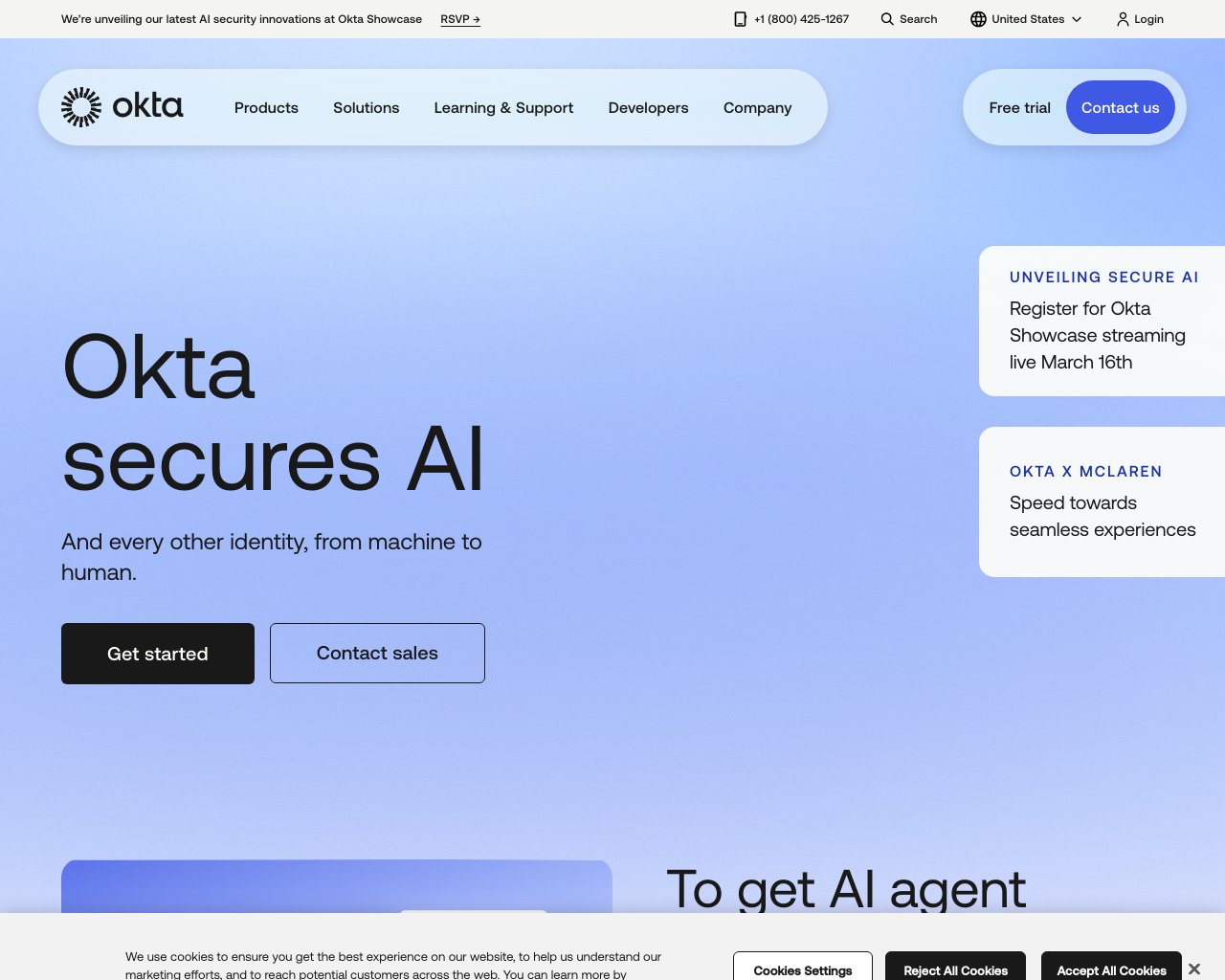
Screenshot
[ features ]
Geostrategic Position
Information on which part of the world this product / vendor belongs to, i.e. the country of their headquarters primarily, but also their hosting options etc.
Find which geostrategic world region the headquarter is located in. Relevant for compliance questions (e.g., CLOUD Act) or risk of cut-off in case of conflicts. For example, some EU companies are worried about the US and would definitely not host their customer with Chinese or Russian companies.
The hosting provider that is used to host this product, if any.
The available hosting locations, if you can choose
Compliance & Security
Security certifications, compliance features, and access control capabilities.
SOC 2 Type I or Type II certification.
ISO 27001 information security certification.
Built-in tools for GDPR compliance (data export, deletion, consent).
Complete audit log of all data changes.
Granular permissions based on user roles.
Single Sign-On integration support.
Developer Experience
Tools and abstractions easing agent development and iteration.
No-code/low-code UI for designing agent workflows.
OpenAI API-compatible endpoints or SDKs.
Available as open-source with community contributions.
Programming languages with official SDK support.
Ready-to-use, customizable UI elements for auth flows.
Self-service admin dashboard for customers to manage users/orgs.
Supported frontend frameworks with dedicated guides/components.
Authentication Methods
Core authentication flows and options supported by the platform.
Supports passwordless authentication via magic links, passkeys, or biometrics.
Supported third-party social login providers.
Supported multi-factor authentication methods.
Built-in protection against bots and automated attacks during auth.
Enterprise Integrations
Protocols and tools for integrating with enterprise identity systems.
Supports SCIM for automated user provisioning and deprovisioning.
Supports syncing users/groups from directories like HRIS or IdPs.
Compatible identity providers for federation.
Just-In-Time user provisioning from SAML/OIDC assertions.
Pricing & Free Tier
Free tier limits and overall pricing structure.
Maximum Monthly Active Users allowed on the free tier.
Key usage metrics that incur costs.
Compare With
Reviews
No reviews yet. Be the first to review Okta!