
AutoGen
Unclaimed verified 5 oct 2026A framework for building AI agents and applications
TL;DR
AutoGen by Microsoft Research is an open-source framework designed to orchestrate conversational, event-driven multi-agent systems and applications. It is built for Python and.NET developers who want to coordinate autonomous agents, tools, and human feedback. Its key differentiator is an asynchronous actor-model architecture that decouples agent communication into message-passing layers with native distributed runtime and sandboxed code execution support.
What Users Actually Pay
No user-reported pricing yet.
Our Take
AutoGen occupies a pioneering position in the autonomous agent landscape. While many commercial LLM platforms focus on linear chaining or prompt routing, AutoGen models interactions as dynamic, conversational multi-agent systems where specialized roles (such as planners, coders, and critics) discuss, critique, and solve open-ended tasks iteratively. The framework underwent a major architectural overhaul in version 0.4, migrating from synchronous chat loops to an event-driven actor model divided across autogen-core, autogen-agentchat, and autogen-ext packages. The framework's strengths lie in its architectural modularity, multi-agent delegation, and native support for sandboxed code execution (via Docker or local environments) as well as Model Context Protocol (MCP) tooling. AutoGen allows developers to prototype quickly with high-level presets in AgentChat or construct distributed, low-level message-passing topologies in Core. Additionally, AutoGen Studio provides a lightweight UI for visual prototyping. However, AutoGen has distinct operational hurdles. Unlike workflow-centric frameworks that enforce deterministic graph state machines (e.g., LangGraph), open-ended multi-agent discussions in AutoGen can result in unpredictable token consumption, tool loops, or difficult-to-control termination conditions. Furthermore, documentation transitions between versions 0.2 and 0.4, alongside community fork divergence, have created occasional ecosystem friction. AutoGen is best suited for AI researchers, experimental engineers, and development teams building open-ended collaborative workflows, distributed agent systems, or automated software engineering agents that require iterative code generation and validation loops.
Alternatives
Ranked by Revuo score — paid tiers never affect order.


Pros
- + Actor-model and event-driven core architecture in v0.4 enabling asynchronous message passing and distributed multi-agent runtimes
- + Native sandboxed code execution via Docker command-line runners and Model Context Protocol (MCP) integration
- + Layered abstraction offering quick templated setups with AgentChat alongside granular low-level runtime control in Core
- + Broad model interoperability across OpenAI, Azure OpenAI, Anthropic, Ollama, and custom endpoints via extensions
Cons
- - Probabilistic multi-agent conversations can trigger runaway token overhead and loop termination issues if not strictly constrained
- - Architectural breaking changes and naming transitions between v0.2 and v0.4 caused ecosystem and documentation churn
- - Code-first open-source SDK lacking out-of-the-box managed enterprise hosting, fine-grained RBAC, or production B2B SaaS controls
Agent Readiness
52/100AutoGen demonstrates strong agent readiness as a code-first, developer-focused framework. It provides rich asynchronous runtime primitives, gRPC distributed worker runtimes, native Model Context Protocol (MCP) tooling, OpenTelemetry observability, and Docker-sandboxed code execution. While it lacks native no-code connectors (such as Zapier or Make) and managed SaaS status pages, it excels in extensibility, documentation depth, and modular multi-agent orchestration.
Last checked Sep 9, 2026
MCP Integrations
1 serverNeeds a self-provisionable API key
Create and manage AI agents that collaborate and solve problems through natural language interacti…
Last checked Sep 18, 2026
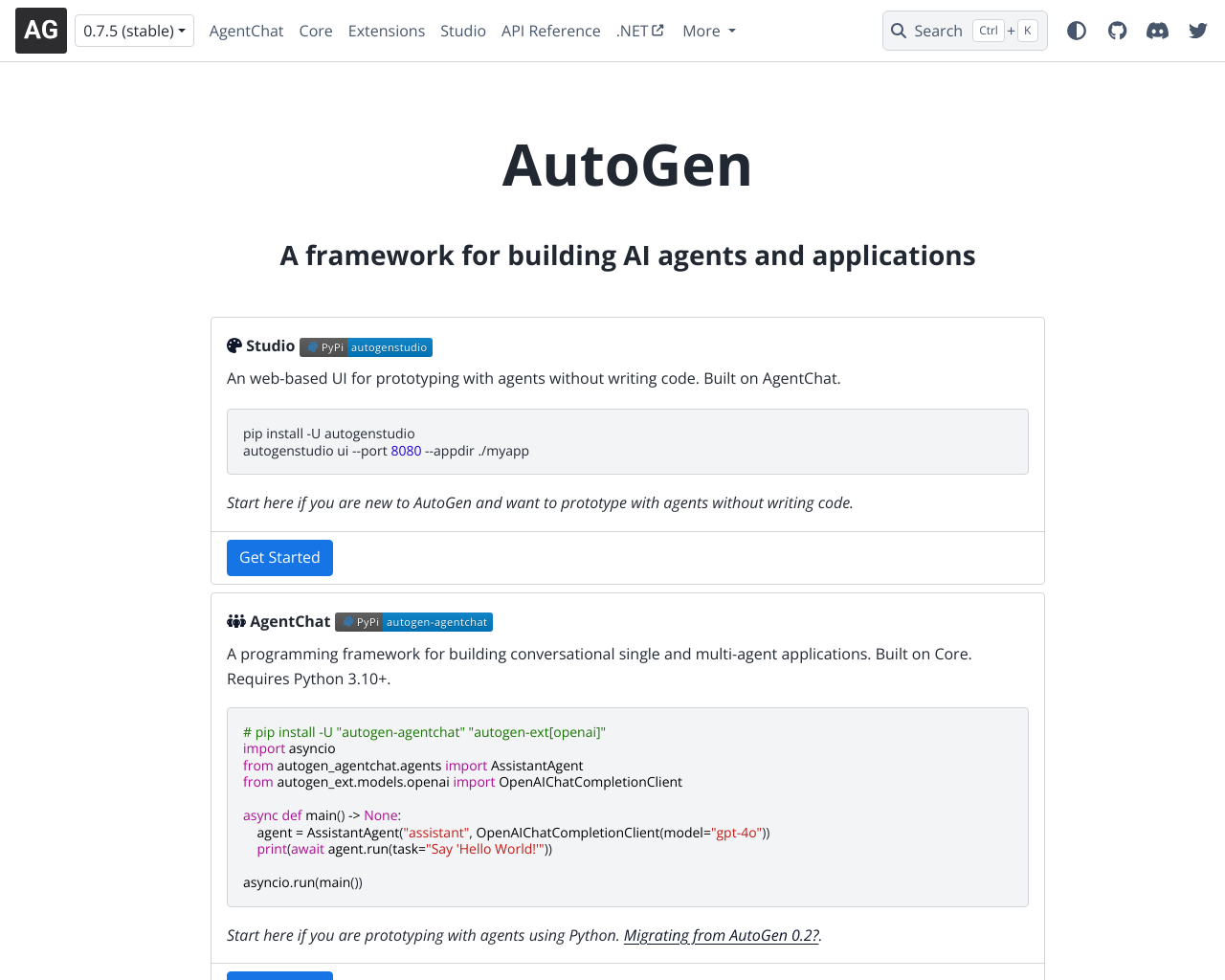
Screenshot
[ features ]
Prompt Management
Editing and tracking of LLM prompts
Allows to version prompts and track / compare different variants over time
Compliance & Security
Security certifications, compliance features, and access control capabilities.
SOC 2 Type I or Type II certification.
ISO 27001 information security certification.
Built-in tools for GDPR compliance (data export, deletion, consent).
Complete audit log of all data changes.
Granular permissions based on user roles.
Single Sign-On integration support.
AI Engine Coverage
Coverage and support for various AI models, LLMs, and search engines.
List of AI models and LLMs supported for tracking (e.g., ChatGPT, Gemini).
How often metrics are updated (e.g., real-time, daily).
Support for tracking in multiple countries or regions.
Orchestration Capabilities
Core features for coordinating and executing AI agent workflows.
Supports orchestration of multiple collaborating agents.
Maintains agent state and memory across interactions.
Automatically routes requests across multiple LLM providers.
Supports agents calling external tools or functions.
Deployment & Scalability
Deployment models and scalability features for production use.
Primary way to deploy and run the orchestration.
Supports multiple teams or users from single deployment.
Automatic scaling for high-load agent workflows.
Compatible with serverless/serverless-like deployments.
Observability & Monitoring
Tools for tracking performance, costs, and debugging agent runs.
Monitors and budgets LLM usage costs per run.
Detailed traces of agent steps and decisions.
Visual graphs or dashboards of agent flows.
Metrics like latency, throughput for agent executions.
Developer Experience
Tools and abstractions easing agent development and iteration.
No-code/low-code UI for designing agent workflows.
OpenAI API-compatible endpoints or SDKs.
Available as open-source with community contributions.
Programming languages with official SDK support.
Compare With
Reviews
No reviews yet. Be the first to review AutoGen!