
LangGraph
Unclaimed verified 4 oct 2026Low-level orchestration framework for building, managing, and deploying long-running, stateful agents.
TL;DR
LangGraph is a low-level orchestration framework and runtime for building long-running, stateful AI agents as explicit graphs of state, nodes, and edges. It is aimed at experienced AI and software engineering teams that need durable execution, human-in-the-loop controls, branching, persistence, and production deployment; its key differentiator is checkpointed graph-based orchestration rather than a simple linear agent loop.
What Users Actually Pay
No user-reported pricing yet.
Our Take
LangGraph occupies the infrastructure and orchestration layer of the agent ecosystem rather than the no-code automation layer. Developers explicitly define state schemas, nodes, routing logic, persistence, and execution behavior, making it suitable for complex workflows where control and recoverability are important. Its strongest capabilities are durable execution, checkpointing, streaming, human oversight, branching, looping, subgraphs, and integration with LangSmith for tracing and deployment. The framework can be used with LangChain components or independently, which gives teams flexibility across model providers and tool implementations. The principal trade-off is complexity. User feedback points to a steep learning curve, difficult state-machine concepts, debugging challenges, fragmented or changing documentation, and operational overhead. These concerns matter less for teams building sophisticated production workflows, but LangGraph may be excessive for simple chatbots or short-lived tool-calling agents. LangGraph is best suited to experienced engineering teams building multi-step, stateful, long-running, or human-supervised agents. It is less suitable for nontechnical users or teams seeking a turnkey automation platform with extensive point-and-click integrations.
Alternatives
Ranked by Revuo score — paid tiers never affect order.


Pros
- + Strong state management for branching, looping, checkpointing, retries, and human-in-the-loop workflows.
- + Well suited to complex multi-agent orchestration and long-running execution.
- + Durable execution allows workflows to persist through failures and resume from interruptions.
- + Flexible ecosystem support across LangChain components, model providers, tools, and custom application code.
- + Provides a production path through local development, self-managed deployment, and LangSmith Deployment.
Cons
- - Steep learning curve, especially for developers unfamiliar with graph or state-machine execution models.
- - Debugging persistent state transitions and granular updates can be difficult.
- - Community feedback reports documentation discoverability issues and examples that can become outdated.
- - May introduce unnecessary conceptual and dependency overhead for simple agents.
- - Rapid ecosystem changes create compatibility and upgrade-management risk.
Agent Readiness
57/100LangGraph has strong readiness for engineering-led autonomous agents. It provides public Python and JavaScript/TypeScript APIs, REST-based Agent Server endpoints, streaming, OpenAPI documentation, authentication hooks, persistence, webhooks, local development, visual debugging, and managed deployment through LangSmith. It is particularly well suited to long-running workflows, human approvals, background jobs, multi-agent routing, and systems requiring resumability or auditability. However, it is not a turnkey automation product: teams must design state models, prompts, tool permissions, business logic, security controls, and operational practices themselves. Native point-and-click integrations for Zapier, Make, and n8n were not identified, and documentation and upgrade-management complexity remain practical adoption concerns.
Last checked Sep 9, 2026
MCP Integrations
1 serverLLM Orchestration Agent (Langgraph)
Last checked Sep 20, 2026
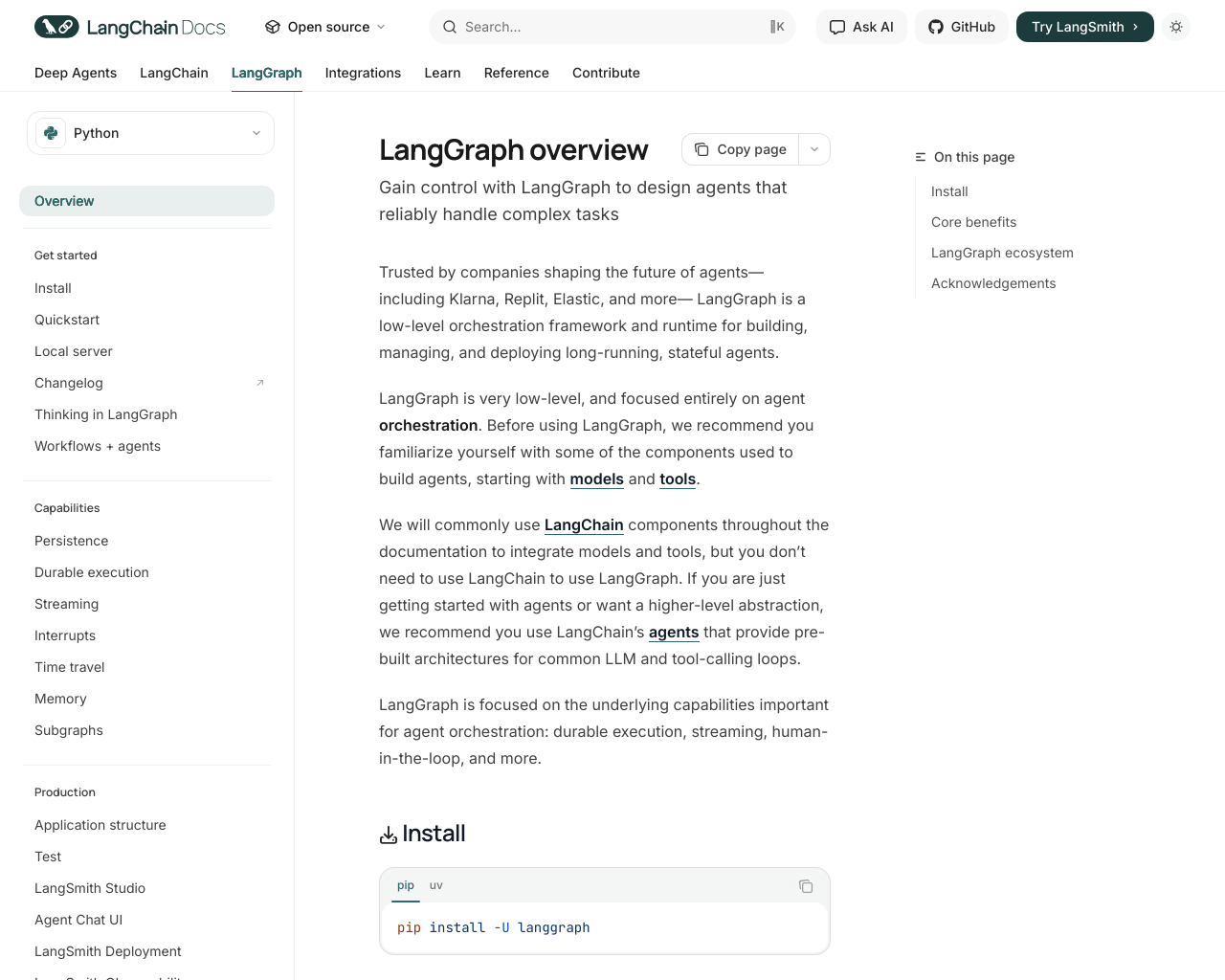
Screenshot
[ features ]
Prompt Management
Editing and tracking of LLM prompts
Allows to version prompts and track / compare different variants over time
Compliance & Security
Security certifications, compliance features, and access control capabilities.
SOC 2 Type I or Type II certification.
ISO 27001 information security certification.
Built-in tools for GDPR compliance (data export, deletion, consent).
Complete audit log of all data changes.
Granular permissions based on user roles.
Single Sign-On integration support.
AI Engine Coverage
Coverage and support for various AI models, LLMs, and search engines.
List of AI models and LLMs supported for tracking (e.g., ChatGPT, Gemini).
How often metrics are updated (e.g., real-time, daily).
Support for tracking in multiple countries or regions.
Orchestration Capabilities
Core features for coordinating and executing AI agent workflows.
Supports orchestration of multiple collaborating agents.
Maintains agent state and memory across interactions.
Automatically routes requests across multiple LLM providers.
Supports agents calling external tools or functions.
Deployment & Scalability
Deployment models and scalability features for production use.
Primary way to deploy and run the orchestration.
Supports multiple teams or users from single deployment.
Automatic scaling for high-load agent workflows.
Compatible with serverless/serverless-like deployments.
Observability & Monitoring
Tools for tracking performance, costs, and debugging agent runs.
Monitors and budgets LLM usage costs per run.
Detailed traces of agent steps and decisions.
Visual graphs or dashboards of agent flows.
Metrics like latency, throughput for agent executions.
Developer Experience
Tools and abstractions easing agent development and iteration.
No-code/low-code UI for designing agent workflows.
OpenAI API-compatible endpoints or SDKs.
Available as open-source with community contributions.
Programming languages with official SDK support.
Compare With
Reviews
No reviews yet. Be the first to review LangGraph!