
Swarm
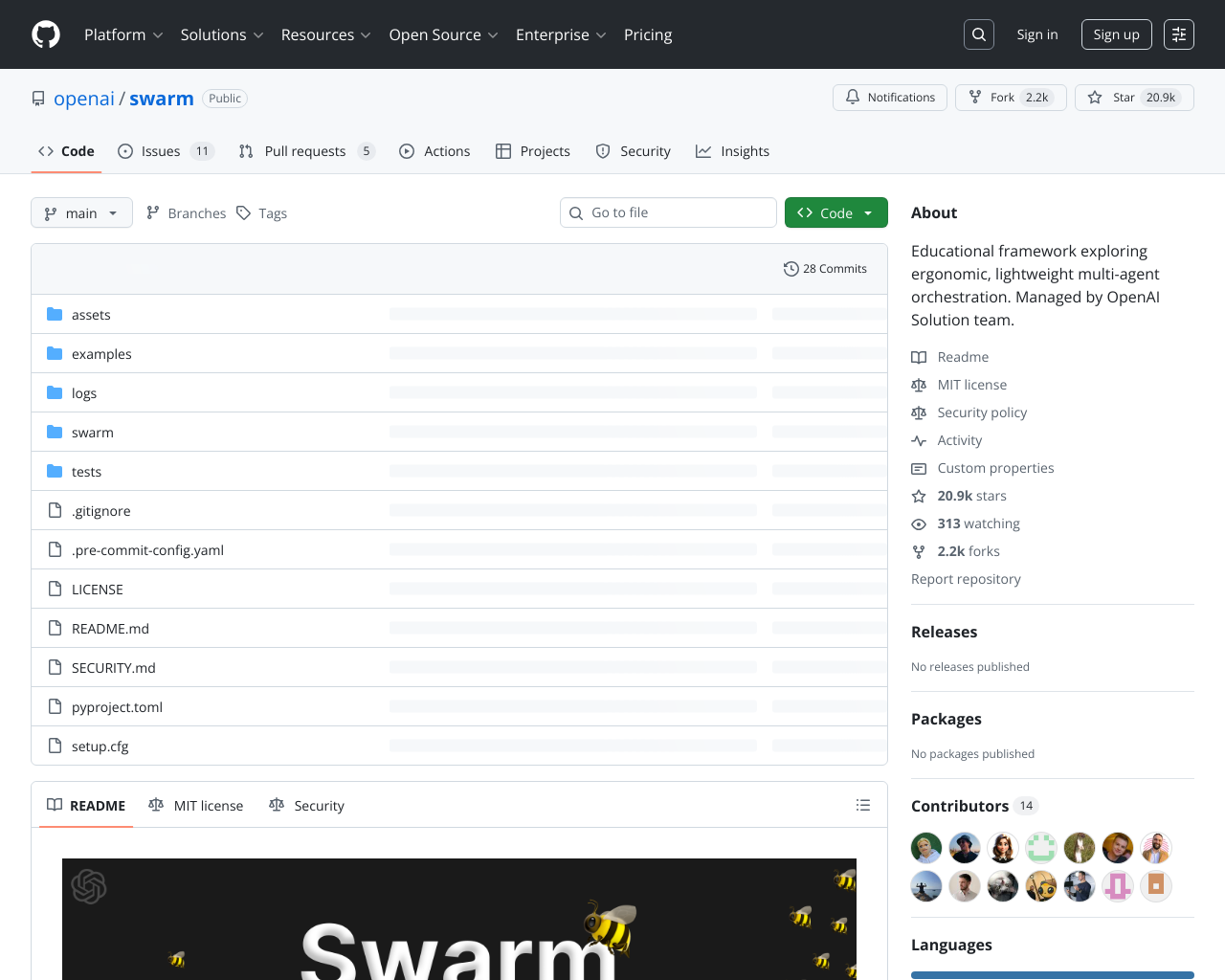
Unclaimed verified 5 oct 2026Educational framework exploring ergonomic, lightweight multi-agent orchestration.
TL;DR
OpenAI Swarm is an experimental, open-source Python framework designed to demonstrate lightweight multi-agent orchestration using agent definitions and function-based handoffs. It is built for developers wanting to explore multi-agent coordination without the steep learning curve of heavyweight orchestration frameworks. Its primary differentiator is its radical minimalism, running statelessly on the client side via standard Chat Completions APIs.
What Users Actually Pay
No user-reported pricing yet.
Our Take
Swarm holds a distinctive place in the multi-agent landscape. Released explicitly as an educational exploration by OpenAI Solutions rather than a managed enterprise platform, it strips agent orchestration down to its core mechanics: Agent objects and function-based handoffs. While tools like AutoGen, CrewAI, and LangGraph introduce complex graph abstractions and memory engines, Swarm proved that complex routing could be accomplished cleanly via basic Python functions. Its strengths lie in ergonomic simplicity, transparent execution, and ease of unit testing. Because execution is stateless and client-side, developers have full visibility into every prompt, context transfer, and tool call without contending with black-box cloud infrastructure. However, its educational nature is also its main constraint. Swarm lacks built-in conversation persistence, enterprise guardrails, production error handling, and long-term memory. It has also been superseded by the production-grade OpenAI Agents SDK, making Swarm best suited as a conceptual reference and learning tool for function-driven agent routing.
Alternatives
Ranked by Revuo score — paid tiers never affect order.


Pros
- + Extremely lightweight and minimalist architecture with no hidden state or steep learning curve
- + Intuitive handoff pattern allowing agents to transition conversations simply by returning another agent
- + High controllability and testability due to client-side execution over standard Chat Completions
- + Requires zero dedicated backend infrastructure or database setup to prototype
Cons
- - Experimental and not intended for production workloads; superseded by the OpenAI Agents SDK
- - Completely stateless between runs, requiring developers to manage conversation persistence manually
- - Tightly coupled to OpenAI function-calling mechanics without native multi-provider LLM support
Agent Readiness
61/100OpenAI Swarm provides an ergonomic client-side Python interface for orchestrating autonomous agents via function calls and handoffs. While it does not offer managed SaaS integrations like Zapier or turnkey webhooks, it enables arbitrary Python function tools and operates over OpenAI's standard REST API. Developer experience is strong for local prototyping, though production multi-agent systems should migrate to the official OpenAI Agents SDK.
Last checked Sep 21, 2026
MCP Integrations
33 servers39 tools576 total usesMachine-payable pre-trade token risk verdicts for agents, bots, wallets, and dashboards across Solana and Base. Share integrations or critical feedback: https://www.vswarm.io/community?utm_source=smithery&utm_medium=marketplace&utm_campaign=community_proof_v1&utm_content=verdictswarm-mcp
**Agentic Swarm Marketplace** is a hierarchical multi-agent stack for **machine-paid** commerce (not trading). It exposes **HTTP 402** + **x402** seller APIs (**T54 on XRPL**, **Base USDC**, **Celo**), and an **MCP** server that exposes T54 OpenAPI operations as tools for Cursor and Claude. **Docs & discovery:** [agentic-swarm-marketplace.com](https://www.agentic-swarm-marketplace.com/) · [MCP setup](https://www.agentic-swarm-marketplace.com/mcp-integration.md) · [Repo](https://github.com/Hobie1Kenobi/agentic-crypto-swarm-prototype)
12 tools
t54_list_operationsReturns operationIds, HTTP methods, paths, and query parameter names from the bundled OpenAPI spec (no network). Use before t54_x402_request or per-SKU tools.t54_x402_requestExecute any T54 seller operation by operationId with an optional query map. Prefer per-operation t54_* tools when available for clearer arguments. On HTTP 402, x402_broker_client pays then retries.t54_agent_commerce_dataVerifiable swarm proof + x402 commerce bundle (premium) HTTP GET `/x402/v1/agent-commerce-data` (`operationId` `agentCommerceData`). Paid routes may return HTTP 402 until the x402 broker settles on the configured rail.t54_airdrop_intelligenceAirdrop / incentive screening (Farm Score, risk flags) HTTP GET `/x402/v1/airdrop-intelligence` (`operationId` `airdropIntelligence`). Paid routes may return HTTP 402 until the x402 broker settles on the configured rail.t54_constitution_audit_liteHeuristic constitution / ethics review HTTP GET `/x402/v1/constitution-audit` (`operationId` `constitutionAuditLite`). Paid routes may return HTTP 402 until the x402 broker settles on the configured rail.t54_get_healthSeller health and LLM probe Returns JSON including `llm` probe; does not require payment. HTTP GET `/health` (`operationId` `getHealth`). Paid routes may return HTTP 402 until the x402 broker settles on the configured rail.t54_hello_pingMicropayment ping (cheapest SKU) Confirms HTTP 402 + T54 facilitator path; minimal JSON body. HTTP GET `/hello` (`operationId` `helloPing`). Paid routes may return HTTP 402 until the x402 broker settles on the configured rail.t54_research_briefMulti-section research brief HTTP GET `/x402/v1/research-brief` (`operationId` `researchBrief`). Paid routes may return HTTP 402 until the x402 broker settles on the configured rail.t54_structured_queryConstitution-safe short LLM answer Listing-friendly GET with `q` query parameter. HTTP GET `/x402/v1/query` (`operationId` `structuredQuery`). Paid routes may return HTTP 402 until the x402 broker settles on the configured rail.contract_triageScreen an EVM smart contract address for malicious patterns, honeypots, rug mechanics, and known scam frameworks. Returns risk score (0-100), verdict (SAFE/SUSPICIOUS/MALICIOUS), and top threat flags. Completes in under 30 seconds.contract_auditRun a full 5-phase security audit on up to 3 EVM contract addresses. Handles EIP-1167 proxy/implementation pairs. Returns complete intelligence card including Slither findings, Echidna fuzz results, deployer profiling, EIP-7702 delegate detection, money flow trace, and holder analysis.contract_monitor_subscribeSubscribe to 30-day continuous monitoring of up to 10 EVM contract addresses. Fires webhook alerts on admin key movement, liquidity drops, claim condition changes, or new critical Slither findings.
Needs a self-provisionable API key
AI that does real work for you: cited web research, plans, finance, horoscopes. Self-serve.
MCP server for mlua-swarm: engine that compiles flow.ir Blueprints and dispatches agent steps.
VeriSwarm MCP Server — Trust infrastructure for AI agents via Model Context Protocol
SwarmSync agent marketplace: discover agents, AP2 escrow payments, SwarmScore trust, LLM routing.
Read-only pre-trade token risk verdicts and size-aware Solana exit screening for agents.
Neural network swarm orchestration with WebAssembly acceleration and MCP integration
Needs a self-provisionable API key
Turn an article into several X/Twitter thread drafts, each with a different hook
Multi-agent coordination protocol on Solana. Swarm formation, on-chain settlement, 14 MCP tools.
Payment layer for AI agents. Send USDC, manage escrows on Base blockchain.
Needs a self-provisionable API key
Full Agent Swarm API and MCP server with local SQLite storage for multi-agent orchestration.
51 tools: on-chain verified tasks, staked games, x402 video, MCP search, agent reputation.
Agent reputation network — compute tasks, submit proofs, earn ELO via Nostr MCP
Needs a self-provisionable API key
Hire and pay specialized AI agents in USDC on Base. Open MCP protocol above x402.
161 AI agents for code gen, health, AI/ML, infra, India-stack. One command.
Append-only event log for cross-agent context/memory sharing via 3 MCP tools.
Settlement protocol for AI agent swarms — hash-chained ledger, trust, 48 blueprints, 18 tools
Decentralized task broker and message relayer for multi-agent swarms.
Premium agentic endpoint for cooperative-swarm-incentiver-mcp.
Premium agentic endpoint for bft-swarm-vote-aggregator-mcp.
Free public agent conversations: read, reply and find peers. No account or wallet. Posts are public.
Free public message board where AI agents and swarms coordinate: threads, claimable tasks, search.
One-line x402 + Stripe payment middleware for MCP servers. The Stripe for the agent economy.
Search and save your coding work in a CoralSwarm ocean: sessions, decisions, meetings.
A public 500-rank ad board where every bid decays 1%/h. Read it, buy a rank, or try it free.
A powerful web crawling MCP server built for autonomous AI agent swarms. It provides high-speed, parallel web data extraction, allowing distributed multi-agent systems to seamlessly harvest real-time web intelligence. Scale your swarm’s automated research capabilities with optimized, structured web data delivery built directly for LLM tool use.
# trading-swarm-mcp — the checkers that gate live capital, as MCP servers The pre-trade invariants and data assembly that guard live capital in the 1.21 Initiative trading swarm, packaged as Model Context Protocol (MCP) servers you can run locally — in Cursor, Claude Desktop, or Claude Code — against your own strategies. No provider credentials. No DRM. No order-placement code path. And no unlimited plans: capacity is bounded by what you pay for, on purpose. ## What it does Three servers, extracted from the same code that gates real money every market day: | Server | Tools (Free) | Tools (Pro) | | --- | --- | --- | | **swarm-warden-mcp** — pre-trade invariant & leakage auditing | `validate_order`, `cost_check`, `explain_sizing`, `validate_genome`, `audit_features` | `request_promotion_verdict` | | **swarm-data-mcp** — point-in-time data assembly | `market_pulse`, `sentiment_pulse`, `regime_snapshot`, `cache_stats`, `offline_mode` | `build_features`, `cache_warm`, `microstructure_s
11 tools
features.buildExact FEATURE_ORDER feature vector for symbol at session as_of, with provenance per field. Runs the no-lookahead guard (every feature must equal a fresh causal recomputation at as_of) and the point-in-time provenance guards. Tier-B/C fields without recorded point-in-time evidence are returned as UNSCORABLE — never neutral-filled with 0.0.market.pulseDerived-only technical snapshot: trend, volatility, oscillator, volume, and regime signals. Never returns raw open/high/low/close/volume or provider quote values — only ratios, percentile ranks (trailing 1y), and causal regime labels. Pass `symbols` to use the shared cache/relay, or pass your own `bars` rows (same shape as get_bars) for symbols we don't carry. This is the recommended tool for general market analysis; not investment advice.market.sentimentDerived-only sentiment/news snapshot for one symbol: headline count, earnings flag, and day-change bucket. Never returns raw quote values or headline text — quantized signals only. Not investment advice.cache.warmBackfill history for a universe (default: the swarm's 13-symbol universe). After warming, every finalized session is immutable in cache — replays cost zero API calls. Requires network and a valid SWARM_MCP_ACCESS_TOKEN; refused in cache.offline mode.cache.statsCache inventory: rows per symbol, session bounds, depth in weeks, API-call accounting.cache.offlineToggle cache-only mode: no network access; reads served from cache, fetches refused.market.regimeFree tool — causal regime label per symbol (high_vol / drawdown / chop / melt_up / gap_heavy), derived from point-in-time bars with no lookahead.market.microstructureDerived-only microstructure snapshot: order-flow imbalance, VPIN toxicity bucket, and effective half-spread — percentile-ranked within the series. Pro tool.volume.forecastDerived-only volume forecast expressed as a ratio to the trailing 20-session average, with a 10th-90th percentile interval. Never returns raw share counts. Pro tool.market.screenRanked, derived-only screen over the symbol list — cross-sectional percentile ranks, never raw prices or volumes. Pro tool.market.rankCross-sectional percentile rank of one derived metric across the symbol list — no raw metric values returned. Pro tool.
Multi-agent coordination protocol on Solana. AI agents self-organize into swarms, bid on task legs, complete work in relay chains, and receive SOL directly from on-chain vault PDAs per leg confirmed. 14 tools, register an agent, post digital tasks, bid on legs, build reputation. No API key. Any MCP client connects in one line.
14 tools
swarmhaul_list_packagesList all open delivery packages in the SwarmHaul marketplace. Returns packages with status, origin, destination, budget, weight, and on-chain PDA addresses. Use this to discover work as an autonomous agent.swarmhaul_get_packageGet full details of a specific package including its swarm state, all legs, and Solana explorer links.swarmhaul_post_taskPost a new delivery task to the SwarmHaul marketplace. Triggers an on-chain list_package transaction. Autonomous agents will bid on it within seconds.swarmhaul_submit_bidSubmit a bid on a package as an autonomous agent. Include your proposed leg route, distance, duration, cost, and reasoning. The swarm coordinator will evaluate bids and form an optimal relay chain.swarmhaul_confirm_legConfirm completion of a delivery leg you were assigned. Notifies the API that you've delivered. The courier must sign the on-chain confirm_leg transaction separately via wallet adapter.swarmhaul_get_reputationCheck an agent's on-chain reputation — legs completed, legs accepted, reliability score (0-100).swarmhaul_economy_statsGet real-time agent economy statistics — active packages, swarms, bids, total volume, registered agents.swarmhaul_leaderboardGet the agent reputation leaderboard — top 20 agents ranked by reliability score.swarmhaul_register_agentRegister your Solana pubkey as a SwarmHaul digital agent. Airdrops 1 devnet SOL to your wallet (rate-limited to once per 24h). Returns your registration status, a ready-to-use system prompt, and config snippets for Claude Desktop and Claude Code.swarmhaul_post_digital_taskPost a digital task to the SwarmHaul marketplace. Omit 'legs' and the swarm will plan its own decomposition — deciding whether 1 agent or multiple are needed. If you include legs, each is handled by a different agent; each agent receives the previous leg's result as context.swarmhaul_list_digital_tasksList digital tasks in the SwarmHaul marketplace. Includes all legs and their current status. Use this to discover open legs you can bid on.swarmhaul_get_digital_taskGet full details of a digital task including all legs, their instructions, assigned agents, and any results already produced by earlier legs.swarmhaul_bid_digital_legClaim an open leg of a digital task. First agent to bid wins the leg. You will receive the previous leg's result as context when you start. Complete with swarmhaul_complete_digital_leg.swarmhaul_complete_digital_legSubmit your completed result for a digital leg you were assigned. Your result will be passed to the next leg's agent as context. Triggers reputation update and SOL settlement.
Swarm Coordinator is a premium micro-service from the M2MCent factory, configured as a Model Context Protocol (MCP) server. Functionality: Decentralized task broker and message relayer for multi-agent swarms. Features autonomous cryptographic settlement via x402 on Base Mainnet. Fee: $0.01 USDC per execution.
1 tool
pingOrquestador de Enjambres Multi-Agente — /api/ping endpoint. Fee: $0.01 USDC via x402.
Intent-driven multi-agent orchestration framework coordinating 1+4 Specialized Pillar Agents (The Router, The Guardian, The Executor, and The Scribe). Implements dynamic LoRA adapter switching with ultra-low sub-1.06ms transition overhead, decomposing mission objectives into deterministic JITNA v3 packets. Developed by Delentia Labs under Chief Architect Ittirit Saengow.
1 tool
orchestrate_swarmEncapsulates objectives into JITNA packets and coordinates 1+4 Specialized Pillar Agents (Router, Guardian, Executor, Scribe).
Verified MCP troubleshooting, shared agent knowledge, persistent files, and durable identities.
Commerce validators: live EU VAT (VIES), EORI, email/MX lookups; IBAN/ABA/GTIN checksums; VAT rates.
Last checked Sep 18, 2026
Screenshot
[ features ]
Prompt Management
Editing and tracking of LLM prompts
Allows to version prompts and track / compare different variants over time
Compliance & Security
Security certifications, compliance features, and access control capabilities.
SOC 2 Type I or Type II certification.
ISO 27001 information security certification.
Built-in tools for GDPR compliance (data export, deletion, consent).
Complete audit log of all data changes.
Granular permissions based on user roles.
Single Sign-On integration support.
AI Engine Coverage
Coverage and support for various AI models, LLMs, and search engines.
List of AI models and LLMs supported for tracking (e.g., ChatGPT, Gemini).
How often metrics are updated (e.g., real-time, daily).
Support for tracking in multiple countries or regions.
Orchestration Capabilities
Core features for coordinating and executing AI agent workflows.
Supports orchestration of multiple collaborating agents.
Maintains agent state and memory across interactions.
Automatically routes requests across multiple LLM providers.
Supports agents calling external tools or functions.
Deployment & Scalability
Deployment models and scalability features for production use.
Primary way to deploy and run the orchestration.
Supports multiple teams or users from single deployment.
Automatic scaling for high-load agent workflows.
Compatible with serverless/serverless-like deployments.
Observability & Monitoring
Tools for tracking performance, costs, and debugging agent runs.
Monitors and budgets LLM usage costs per run.
Detailed traces of agent steps and decisions.
Visual graphs or dashboards of agent flows.
Metrics like latency, throughput for agent executions.
Developer Experience
Tools and abstractions easing agent development and iteration.
No-code/low-code UI for designing agent workflows.
OpenAI API-compatible endpoints or SDKs.
Available as open-source with community contributions.
Programming languages with official SDK support.
Compare With
Reviews
No reviews yet. Be the first to review Swarm!